
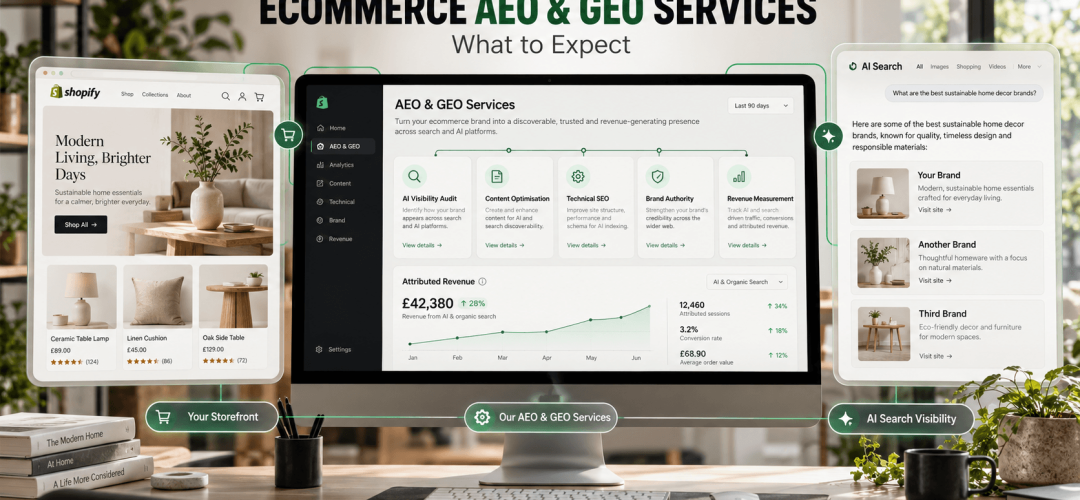
No provider can guarantee that ChatGPT will mention your store. Ecommerce AEO and GEO services can promise defined work instead: an AI visibility audit, content optimisation, technical fixes, brand entity work and measurement. Judge a service by the work it delivers and the evidence it tracks.
You ask ChatGPT for the best store in your category. It names three competitors and skips yours. That moment shows what has changed: some buyers now get a shortlist from an AI tool before they ever reach your site. The fix is a set of defined jobs inside AEO for ecommerce and GEO for ecommerce. Once you know what they are, you can hire with confidence and spot a vague pitch fast.
If your last agency handed you a rankings chart and no orders, hold any new provider to a higher standard. Ask what it will change in your Shopify store and how it will show the result next to your orders.
These services help AI tools find your store and describe it accurately. For the service itself, see What’s Included in Ecommerce AEO and GEO Services, and What Should You Expect?
Answer Engine Optimisation (AEO) makes your content the clear answer to a buyer’s question. Generative Engine Optimisation (GEO) shapes how AI models represent your brand and products. Ecommerce GEO applies that to your catalogue, so AI tools describe your products correctly when buyers ask.
A solid service usually combines five things:
- An AI search visibility audit
- Content optimisation for products, collections and buying questions
- Technical accessibility, so AI tools and search engines can read your pages
- Brand entity development, so AI tools describe your business consistently
- Measurement that ties visibility to commercial results
Together, these can improve product discoverability and open commercial opportunities. They do not promise rankings, citations or sales. Any provider that does is overpromising.
What Do AEO and GEO Services Actually Include?
Good AEO and GEO services work in two layers. Foundational work makes your store easy to crawl and easy to trust. Specialist work targets how AI tools choose and describe brands.
Technical SEO, content, structured information, brand authority and measurement all feed each other. A schema fix means little if the product copy is thin. Strong copy cannot help if AI crawlers cannot reach the page. That is why AEO for ecommerce works best when technical, content and brand work run as one program.
| Component | What it covers | What you should receive |
| Visibility audit | AI answer testing and competitor benchmarks | Baseline report and priority list |
| Content optimisation | Product, collection and buyer content | Revised copy, specs and FAQs |
| Technical work | Crawlability, indexing, structured data, internal links | Fix list and implemented changes |
| Brand entity work | Consistent brand and product information | Entity gap review and updates |
| Measurement | Prompt tracking, referrals, conversions, revenue | Repeatable reporting |
At iWeb Power, we run these as one Shopify-focused program. Buyers keep asking whether an agency understands Shopify rather than generic SEO, and that question is fair. Specialist ecommerce GEO services then build on this base. They target how AI models describe your brand and products.
AI Search Visibility Audits and Competitor Benchmarking
An AI visibility audit sets your baseline. It shows how AI tools describe your store today and who they name instead.
A strong audit covers:
- AI prompt sets built around real buyer questions, both branded and non-branded
- Brand and product mentions across major AI tools
- AI citations, so you see which pages AI tools rely on
- Competitor benchmarks for the same prompts
At iWeb Power, we score each AI answer for relevance, accuracy, presence and prominence. We then rank opportunities by impact and feasibility.
The findings decide your ecommerce GEO priorities. If AI tools cite competitor buying guides, you build better guides first. If they misstate your products, you fix product information first.
Know the limits. AI answers can change by wording, location and time, so one test proves little. Ask for a repeatable method, and ask what evidence the agency can show from past audits. Run an AEO and GEO audit for ecommerce before you invest, so you know what needs fixing first.

Product, Collection and Buyer-Focused Content Optimisation
AI tools answer purchase questions, so your pages need to answer them first. That is the core of AEO for ecommerce.
Typical improvements include:
- Product descriptions that state use, materials, sizes and compatibility plainly
- Collection pages that explain how to choose between products
- Specifications and comparison information in a consistent format
- Buyer guides and FAQ content that answer questions shoppers ask
Clear, consistent product information also helps machines read your pages. Mixed units, vague attributes and missing specs make that harder. A vague description gives AI tools little to work with, so a competitor’s clearer page may be used instead.
For Shopify AEO, product and collection pages are where buyer questions get answered. Our post on getting ecommerce products recommended by AI search covers the product-level tactics.

Technical SEO, Structured Data and Internal Linking
Technical AEO work makes sure AI tools and search engines can reach your pages and understand them. Your agency should check:
- Crawlability and indexing, so key pages stay discoverable
- Canonical URLs, so duplicate versions do not split signals
- Structured data, which is code that labels details such as price, availability and reviews
- Internal links that connect collections, products and guides
- Shopify themes and apps, which can limit all of the above
Shopify GEO work depends on these basics, because AI tools cannot describe pages they cannot read. In one iWeb Power audit, a client’s product descriptions, specs and reviews only loaded after JavaScript ran. Moving them into the initial page HTML gave AI crawlers something to read.
Structured data labels details such as price and availability, so machines read them without guessing. It cannot guarantee AI citations. Google says no additional requirements or special optimisations are needed to appear in its AI features, and no special markup or schema is required. That is why the work is mostly careful SEO: clear product information and pages AI tools can read.
Any markup you do use should match the visible page text. Our post on schema markup for AI search explains what it can and cannot do.

Brand Entity Clarity and Supporting Authority
Brand clarity sits at the centre of GEO for ecommerce. Brand entities are how AI tools recognise your business as one distinct, consistent thing. If your name, products and claims differ across sources, AI tools have conflicting facts to choose between and may describe you wrongly.
Agencies usually assess these signals when building an ecommerce GEO strategy:
- Consistent brand names, descriptions and product details across your site and profiles
- Product expertise shown through real content, not claims alone
- Verifiable claims, such as certifications, policies and specifications
- Supporting content that backs up what you say
- Relevant third-party references, such as reviews and trade mentions
Ask how an agency scores these signals and what it changes when it finds gaps. Those questions matter most when evaluating Shopify GEO services.

AI Visibility Reporting and Ecommerce Revenue Measurement
AI search measurement is easy to get wrong. Good reporting from AEO and GEO services keeps five things apart.
| Measure | What it tells you | Main limit |
| AI mentions | Your brand appears in an AI answer | Answers vary by prompt and over time |
| AI citations | An AI answer names or links to your page as a source | A citation is not a visit or a sale |
| AI referral traffic | Visitors arrive from AI tools | AI visits with no recognisable referrer and no UTM tags drop into direct traffic |
| Conversions | Visitors take an action you track | Needs a clean GA4 and Shopify setup |
| Shopify-attributed revenue | Orders linked to a visit under Shopify’s attribution rules | Attribution is not incremental ROI |
Google Search Console covers Google’s own surfaces, so ChatGPT, Claude and Perplexity activity never appears in it. Google introduced generative AI performance reports on 3 June 2026 and rolled them out in stages: one for Search, covering AI Overviews and AI Mode, and a separate one for Discover. Data in both starts on 18 May 2026. Both show impressions only, with no clicks, click-through rate, average position or query data.
Google Analytics 4 (GA4) can group visits from AI tools in its AI Assistant channel, but visits that lose their source details land in direct traffic. Google’s own AI Overviews and AI Mode count as Organic Search instead. GA4 labels them (direct) / (none). That happens after redirects, URL shorteners and ad blockers, or when a link has no UTM tags. Shopify credits revenue under its own attribution rules.
Each tool answers a different question: Search Console shows appearances, GA4 shows arrivals and Shopify shows orders. No single tool proves that AI search drove a sale.
For one iWeb Power client, Shopify Marketing Attribution credited $4,180 AUD in August 2026 sales to ChatGPT referrals, inside $84,123 AUD of SEO-attributed revenue across 89 orders in total. It shows ChatGPT referrals can register in Shopify’s reporting. It does not prove what caused them.
Ask your agency to put Shopify-attributed orders beside the AI visibility numbers and to name what each figure cannot prove. Treat attributed revenue as evidence, not proof of incremental return. That caution applies whenever you are measuring AI search visibility and revenue together.

How Are AEO and GEO Services Different From Traditional Ecommerce SEO?
AEO and GEO services share a foundation with traditional SEO. A store that search engines cannot crawl or trust will struggle in AI tools too. The differences sit in objectives and deliverables.
| Comparison point | Traditional SEO | AEO | GEO |
| Main objective | Rank pages for relevant searches | Be the clear answer to specific questions | Shape how AI models describe and recommend your brand |
| Typical deliverables | Keyword mapping, on-page and technical fixes, links | Answer-first content, FAQs, structured data | Brand entity work, citation analysis, prompt tracking |
| Main measure | Rankings, organic traffic, revenue | Answer presence, citations | Mentions, citations, accuracy of descriptions |
In practice, AEO adds answer-first content. GEO for ecommerce adds brand and citation work on top of the SEO foundation.
That is why AEO and GEO reporting cannot copy SEO reporting. Rankings show where a page sits. Citations show whether an AI tool uses it.
These disciplines overlap heavily, so the best programs run them together. At iWeb Power, we build one plan across SEO, AEO and GEO so work is not duplicated. When you compare providers, ask which deliverables belong to each discipline and what evidence backs them.
We keep definitions short here because our post on AEO vs SEO vs GEO for ecommerce covers them in full.
How Do AEO and GEO Services Work for Shopify and Shopify Plus Stores?
Shopify has platform rules that generic ecommerce advice ignores. Good Shopify AEO services plan around how your product pages and collection pages are built. They also cover Shopify product variants, themes, apps, structured information and commercial landing pages. Shopify GEO work follows the same rules, because AI tools read the same product and brand information.
Shopify Plus stores can bring more moving parts, such as larger catalogues, more apps and heavier theme customisation. That calls for tighter coordination. The core work stays the same, but the planning takes more care.
Which Shopify Pages Should Be Optimised First?
Shopify AEO and Shopify GEO work should start where commercial value and feasibility meet. Four factors set the order: search intent, commercial value, existing visibility and technical feasibility. Start with pages that already earn clicks or ad spend. They show proven demand and give you the fastest read on whether a change worked.
| Page type | Why it matters | Typical priority |
| High-value collection pages | Capture broad buying intent and link to products | Often first |
| Product detail pages | Carry the specs, price and availability AI tools may quote | Best sellers first |
| Buyer guides | Answer pre-purchase questions and support collections | When the audit shows gaps |
| Brand pages | Clarify who you are and what you stand for | Early if entity gaps exist |
Ask any agency to show how it ranks your pages and why. A clear answer is a good sign.
What Shopify Technical Limitations Should Your Agency Account For?
Shopify has platform quirks. A capable agency plans for these before starting any Shopify GEO or Shopify AEO changes:
- Theme-generated schema: many Shopify themes output their own structured data, which can clash with app or custom markup
- App conflicts: several Shopify apps can add schema, scripts or redirects that collide
- Duplicate URLs: one product can load under a /collections/…/products/… path and with a ?variant= parameter, so the canonical should point to the base /products/ URL
- Variant handling: Shopify product variants need clear, consistent data for each colour and size
- Performance: heavy apps and scripts slow your pages
- Platform constraints: some changes need code work or fall outside what Shopify allows
These issues compound. A theme and an app can each output schema for the same product. Variant URLs can repeat one product page under several addresses.
Together, they can send conflicting signals about one product, so check your Shopify themes and apps before any change.
Sometimes the best fix needs a developer. Other times a compromise beats a custom build. A good agency explains the trade-off and the risk before it touches your theme.
What Does an AEO and GEO Service Engagement Look Like From Audit to Reporting?
A well-run engagement follows a clear sequence. Each stage should end with something you can see and approve.
| Stage | What happens | What you receive |
| Discovery | Goals, products, markets and access are reviewed | Scope and access checklist |
| Baseline assessment | AI answer testing and competitor comparison | Baseline report |
| Prioritisation | Fixes are ranked by value and effort | Prioritised roadmap |
| Implementation | Technical, content and brand changes go live | Change log and updated pages |
| Quality assurance | Pages and markup are checked after changes | QA checklist |
| Reporting | Visibility and commercial results are reviewed | Repeatable report |
Discovery comes first. The three steps below cover the rest, from the baseline to reporting.
A narrow audit costs less than ongoing implementation across a large catalogue. Ask who edits your Shopify backend, you or the agency, because that changes both cost and speed. Buyers also want to know how fees are structured. Scope is the main driver of AEO and GEO services pricing.
Step 1: Establish Your AI Search Visibility Baseline
Every ecommerce GEO program starts by recording where you stand before any changes. This AI visibility assessment repeats the audit above in a form you can rerun: the same AI prompt sets, the same competitor benchmarks and a record of existing citations. Document every result, because a repeatable method matters more than any single answer. Ask any agency to show an example baseline from past work.
Step 2: Prioritise and Implement Commercially Relevant Improvements
Next, the agency ranks fixes and starts work. Technical fixes, content improvements, internal links and brand information all compete for time, so ranking them matters. Content fixes tend to lead AEO for ecommerce work, while consistent brand and product information supports Shopify GEO. Internal linking is a common early task because you control it directly.
Agree who does what. The agency may write copy and brief developers. You may approve changes, supply product facts or run theme edits.
Your internal skills and resources shape that split. It is the core of the in-house vs agency AEO and GEO services decision.
Step 3: Re-Measure Visibility and Review Commercial Performance
Then you measure again to judge whether the AEO and GEO services are working. For ecommerce GEO, test the same AI prompt sets the same way each time. Monitor citations and AI referral traffic, then review conversions and revenue.
Be careful with conclusions. An improvement you observe is not proof the work caused it. Prompt results shift, seasons change and other channels move. Good reporting shows the numbers and says plainly what remains uncertain.

What Results Should Ecommerce Brands Realistically Expect From AEO and GEO Services?
Realistic aims are practical, not dramatic:
- Better, clearer product information
- Improved technical accessibility
- Clearer representation of your brand in AI answers
- Potential for qualified discovery from AI tools
Uncertainty is part of GEO for ecommerce. AI tools change often, so ecommerce GEO results can shift without any change on your site, and measurement is imperfect. Costs are real, so the work must justify itself commercially.
Compare the cost with your margins and the value of a qualified customer. That comparison is the core of deciding whether AEO and GEO services are worth the investment.
An audit can give you a clear picture of what is broken. It can also give you a competitor analysis and a practical plan with clear priorities. It cannot give you guaranteed AI citations, guaranteed rankings, guaranteed revenue or results without implementation.
Anyone who promises AI recommendations or guaranteed revenue is overpromising. Real results build over time.
What Should You Check Before Hiring an AEO and GEO Service Provider?
Use this checklist when you compare AEO and GEO services.
| Check | What to ask |
| Ecommerce expertise | Which stores have you worked on, and what did you change? |
| Shopify technical knowledge | How do you handle theme schema, variants and app conflicts? |
| Audit methodology | Is your prompt testing repeatable, and can I see a sample? |
| Deliverables | What do I receive at each stage? |
| Implementation capability | Who makes changes in my Shopify backend? |
| Reporting transparency | Which metrics do you report, and what are their limits? |
| Evidence standards | What evidence can you show before I sign? |
| Commercial accountability | How do you tie work to revenue without overclaiming? |
Each check guards against a failure you cannot see in a sales pitch. Be wary of guarantees and vague deliverables, and of dashboards that show only mentions. These checks matter most when choosing an AEO and GEO agency, and a strong provider answers them plainly.

How Do You Decide Whether Your Ecommerce Store Needs AEO and GEO Services Now?
Some signals suggest your store needs AEO and GEO services now:
- Competitors appear in AI answers where you do not
- You lack in-house skills to run the work
- Product information is unclear, thin or inconsistent
- Technical issues block crawling or indexing
- Competitive pressure is growing, and paid ads carry more of your orders than you want
Sometimes foundational SEO must come first. Your collection pages might be thin. Your site might have indexing problems, or your product data might be incomplete.
If you see these gaps, an agency should fix them first inside the same plan. Specialist Shopify AEO work builds on them, so skipping them wastes budget. A good agency tells you so, even if it shrinks the project. That honesty is part of knowing when to hire an AEO and GEO agency.
Frequently Asked Questions About AEO and GEO Services
Buyers ask the same handful of questions before they sign for AEO and GEO services. Here are short answers.
What is AEO and GEO?
AEO (Answer Engine Optimisation) makes your content the clear answer to a specific buyer question. GEO (Generative Engine Optimisation) shapes how AI models describe and recommend your brand. Both build on traditional ecommerce SEO rather than replace it. Our explainer on what is GEO for ecommerce goes deeper.
Is AEO a part of GEO?
AEO and GEO overlap, but people do not define them as a strict hierarchy. AEO leans toward earning direct answers, while GEO leans toward brand representation across AI models. Neither replaces SEO. Our explainer on what is answer engine optimisation sets out the practical differences.
Can AEO and GEO Services Guarantee AI Recommendations?
No. AI tools such as ChatGPT, Claude and Perplexity decide what to mention or cite, and no provider of AEO and GEO services controls those choices. You can expect measurable work instead: an audit, content and technical fixes, tracked prompts and honest reporting. Judge a provider by those deliverables.
Do Shopify Stores Need Separate AEO and GEO Services?
Usually not. Shopify AEO and Shopify GEO draw on the same product data, theme and app setup. An integrated SEO, AEO and GEO program avoids duplicated work and keeps your measurement in one place. Separate specialists can add depth in narrow areas, but they need strong coordination.
How Long Does It Take to Evaluate AEO and GEO Improvements?
Evaluating AEO and GEO services happens in stages. The audit finishes first, then implementation, then early observations, then longer-term review. We avoid fixed timelines because results depend on your store, your category and your changes. Ask any agency to set review points and name the evidence it will show at each one.
Conclusion: What Should You Expect From a Commercially Accountable AEO and GEO Strategy?
A commercially accountable strategy has clear deliverables and Shopify-specific implementation. It runs one plan across SEO, AEO and GEO. It measures honestly, and the provider answers for its work.
Expect defined deliverables and honest reporting from AEO and GEO services, not guarantees. Your next practical step is to test any ecommerce GEO proposal against the checks above before you sign.
Find Out What Your Shopify Store Needs Before Investing in AEO and GEO
Not sure where your store stands with Shopify AEO and Shopify GEO? We assess technical readiness, AI search discoverability, product visibility and commercial opportunities for established Shopify businesses. Explore iWeb Power AEO and GEO Services for Ecommerce or request an assessment of your store to get started.
