
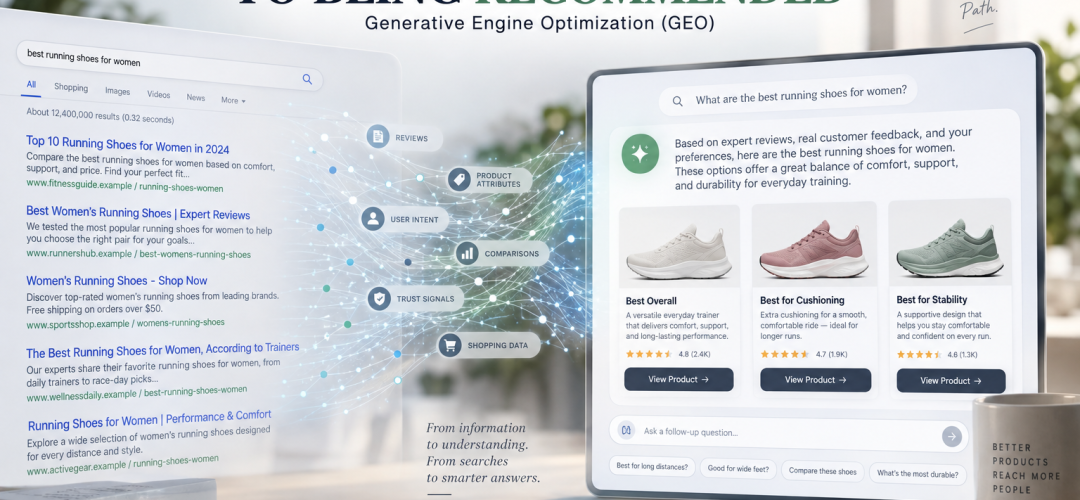
Generative Engine Optimization (GEO) is the practice of making your brand and products easier for AI tools like ChatGPT, Claude, Perplexity and Google AI Overviews to find, understand and recommend. Instead of chasing rankings and clicks, GEO focuses on clear entity information, complete product data and content structured so generative engines can pull it into their answers.
A shopper typing “best waterproof hiking boots under $200” into ChatGPT gets a short list of recommendations back, no scrolling, no ten blue links. Most store owners still optimise for a search results page fewer shoppers use. The insight is simple: visibility now depends on whether an AI engine understands your brand well enough to mention it. Whether your store shows up in that shortlist is quickly becoming a bigger decision than where you rank on page one.
This guide breaks down what Generative Engine Optimization actually means, how it works, and where it fits alongside your existing SEO. Brands ready to put it into practice can explore our Generative Engine Optimization (GEO) services (built into every retainer by default, not sold as a later add-on) along the way. By the end, you’ll know exactly what generative engines need from your store to consider recommending you.
What Is Generative Engine Optimization?
Generative Engine Optimization (GEO) means structuring your brand, product and content information so AI-driven search tools can understand it, trust it and use it in their generated answers. It’s not about ranking on a page. It’s about being clear enough that an AI system can confidently describe what you sell and who it suits.
What Is the Goal of GEO?
GEO aims to influence how your brand shows up across generative search experiences. That includes:
- Being mentioned by name in an AI-generated answer
- Being cited as a source behind a recommendation
- Having your products suggested when a shopper describes a need
None of this is guaranteed. GEO improves the odds by giving AI systems clear, complete information to work with.
What Are Generative Engines?
Generative engines are AI systems, like ChatGPT, Claude, Perplexity, Google AI Overviews and Gemini, that generate a written answer instead of a list of links. A traditional search engine hands the shopper a set of results to click through. A generative engine reads across many sources, then writes a single answer, often naming specific brands or products along the way. For a Shopify store, that shift is the whole game: your product either gets named in that one answer, or it doesn’t exist to that shopper.
How Does Generative Engine Optimization Work?
GEO works through four sequential gates: discovery, retrieval, understanding, and inclusion. Each one is a checkpoint your store has to clear, and failing any single gate is enough to keep a page out of a generated answer, even if that page ranks well and gets plenty of traffic from traditional search. Here’s the sequence:
- Discovery. The AI’s crawler has to find the page exists at all.
- Retrieval. The page has to be accessible enough for that crawler to pull its content.
- Understanding. The AI has to parse what the page is about: which brand, which product, which attributes.
- Inclusion. Only once the first three gates are cleared can the AI decide the page is relevant enough to mention, cite or recommend.
A well-ranked, popular page can still fail at gate two if it’s blocked or slow to load, or at gate three if its product information is vague. That’s the mechanism behind a lot of otherwise strong pages missing out on AI visibility: it’s rarely one big failure, it’s usually a single gate quietly closing.
How Generative Engines Find Information
Generative engines can only use what they can access. Each one sends its own crawler, GPTBot for ChatGPT, PerplexityBot for Perplexity, ClaudeBot for Claude, and Google-Extended for Google’s AI features, and if any of those are disallowed in robots.txt, blocked, buried, or missing basic technical access, that engine can’t retrieve the page in the first place. Accessible, well-structured pages, confirmed against llms.txt and robots.txt, are the entry point for everything else.
How Generative Engines Understand Brands and Products
AI systems understand brands and products as entities, not just keywords. An entity is a distinct “thing” the AI can identify, like your brand, a product line, or a specific model, along with its attributes and how it relates to other entities.
Brand → Category → Product Relationships
Clear relationships help AI systems place your products in context. When your brand, categories and products are explicitly connected, an AI engine can understand what you sell and how your catalogue is organised.
Product → Attribute → Value Relationships
Each product needs clear attributes and values attached to it, such as size, material or capacity. Vague descriptions leave the AI guessing, and it won’t recommend what it can’t confidently describe.
How Information Can Appear in AI-Generated Answers
Once a generative engine understands your brand, it can potentially mention, cite, reference or recommend you in a generated answer. This depends on relevance to the query and how well your information matches what the AI needs. Inclusion is never guaranteed, but clear information gives you a real shot at it.
GEO vs SEO: What’s the Difference?
| Dimension | SEO | GEO |
| What it optimises for | Search rankings and click-through | Being understood, cited and recommended |
| What it measures | Rankings, organic traffic, clicks | Mentions, citations, AI-referred traffic |
| Which systems it affects | Google, Bing and other search engines | ChatGPT, Claude, Perplexity, Google AI Overviews, Gemini, Microsoft Copilot |
GEO and SEO share the same foundation: a fast, accessible, well-structured website. Where they differ is in what visibility looks like.
How SEO Visibility Differs From GEO Visibility
SEO visibility means ranking and getting clicked. GEO visibility means being understood well enough to get mentioned, cited or recommended inside someone else’s answer. The two overlap heavily, though: a site with strong technical SEO and clear content is already halfway to being GEO-ready.
Does GEO Replace SEO?
No, GEO does not replace SEO. Traditional search still drives significant traffic for most ecommerce stores. A closer GEO vs SEO comparison shows the two working best as layered priorities, not competing ones, with GEO sitting on top of the SEO work you’re already doing.
How Does GEO Relate to AEO?
Answer Engine Optimization (AEO) and GEO are closely related, but not identical. Getting clear on “what is Answer Engine Optimization (AEO)” helps separate the two: AEO focuses on structuring content to directly answer specific questions, while GEO focuses more broadly on how your brand and products are understood and represented across generative search as a whole.
How AEO and GEO Work Together
Answer-focused content and strong entity information work together. AEO helps your content directly answer a shopper’s question. GEO helps the AI understand your brand well enough to trust that answer. An AEO vs SEO comparison makes a similar point: the two share the same technical foundation but aim at different outcomes, and together with GEO they form parts of a broader AI search strategy.
Why Is GEO Important for Ecommerce?
Ecommerce shoppers increasingly research and compare products through AI tools before they ever land on a store. McKinsey research shows more than a third of consumers in France, Germany and the UK now use generative AI tools to research products and decide what to buy. If your brand isn’t clearly represented, you’re invisible at exactly the moment a shopper is deciding what to buy.
That invisibility is the real cost of a keyword-only approach. A page can be built entirely around ranking well and still fail to work as source material for a generated answer: it can climb to position one on a search results page and still be too thin, too vague, or too hard to parse for an AI system to lift anything from it. The tradeoff worth understanding is that ranking optimises for click-through, while GEO optimises for extractability, and a store that only does the first is leaving the second entirely up to chance. For stores leaning heavily on paid ads to fill that gap, the risk compounds: an account suspension or a sudden jump in CPC can cut off a channel overnight, and a store with no organic or AI-search visibility has nothing to fall back on while it’s resolved.
AI Search Is Changing Product Discovery
Shoppers now use AI search to research, compare and shortlist products before visiting any website. L.E.K. Consulting’s research shows AI platforms have overtaken traditional search engines as the starting point for purchase research among AI users in the U.S. This shifts part of the discovery journey away from traditional search results and into a single AI-generated answer, which is exactly why ecommerce AI search optimization now sits alongside traditional SEO on most stores’ roadmaps.
GEO Can Support Brand and Product Visibility
Clear, well-structured brand and product information gives you a better chance of appearing in these AI-driven research moments. It won’t guarantee a mention, but it removes the barriers that stop an AI system from considering you at all.
What Is Ecommerce GEO?
Ecommerce GEO applies the same principles to an online store’s specific structure: brands, categories, products and commercial attributes, all connected in a way generative engines can follow.
What Information Matters for Ecommerce GEO?
Generative engines need several layers of information to understand an ecommerce business properly.
Brand Information
Consistent brand identity and information across your site and beyond it. Inconsistent naming or fragmented details make it harder for an AI to build a confident picture of who you are.
Category and Collection Information
Clear relationships between categories and collections give AI systems context for where each product sits. This helps an engine understand your catalogue structure, not just individual items.
Product and Attribute Information
Detailed features, specifications and use cases for every product. The more complete this information is, the easier it is for an AI system to match your product to a shopper’s need.
How Do You Optimize an Ecommerce Website for GEO?
Knowing how to optimize for AI search engines comes down to seven practical steps. Each one addresses a specific point of failure: skip it, and there’s a predictable reason your store drops out of consideration.
Make Important Content Accessible
Confirm your key commercial and informational pages are crawlable and indexable, and that GPTBot, PerplexityBot, ClaudeBot and Google-Extended aren’t disallowed in your robots.txt. If an AI system can’t access a page, nothing else on this list matters: the strongest product copy and the cleanest schema are invisible to a crawler that never gets in.
Establish Clear Brand and Entity Information
Keep your brand name, description and key details consistent across your site, social profiles and any third-party listings. Inconsistent naming is what causes entity conflation: an AI system encountering slightly different versions of your brand name across different sources may treat them as separate, less credible entities rather than recognising them as the same business, which weakens its confidence in anything it says about you.
Create Complete Product Information
Every product page should give an AI system enough factual detail to describe the product accurately. Missing attributes are the most common reason a product gets left out of a generated answer: when a model can’t confirm a specific detail, it’s more likely to skip the product than guess at it.
Define Product Features and Specifications
List precise, factual details for each product: dimensions, materials, capacity, and anything else that defines it.
Explain Benefits and Use Cases
Connect each feature to a real customer problem or situation. A spec sheet tells an AI what a product is. Use cases tell it who the product is for.
Structure Content Around Relevant Questions
Write content that directly answers the questions your customers are asking. Dense paragraphs without a clear question-to-answer structure force an AI system to infer what you meant, and inference is exactly where it’s most likely to give up and cite a competitor’s more directly formatted page instead.
Build Semantic Relationships Across Your Store
Connect your brand, collections, products, attributes and use cases through your site’s internal structure and content. Without these connections, individual pages read as isolated facts rather than parts of a coherent brand, which makes it harder for an AI system to place a specific product in its full context.
Implement Relevant Structured Data
Structured data, built on the Schema.org vocabulary and implemented as JSON-LD, acts as a machine-readable layer that supports your product, brand and commercial information. Product, Offer, BreadcrumbList and Organization schema each describe a different part of your store, while attribute pairs like hasVariant and additionalProperty spell out variants and specs an AI system might otherwise have to infer. Google’s own documentation confirms structured data isn’t required for AI Overviews or AI Mode specifically, but it still helps pages qualify for the rich results those AI features can draw from. Getting schema markup for AI search right doesn’t replace good content, but it reinforces what’s already there.
Strengthen Brand Authority and External Signals
Look for opportunities to build corroborating mentions and references to your brand and products elsewhere online: customer reviews, a Trustpilot profile, press coverage, a Wikipedia or Wikidata entry, and backlinks from sites in your category. Without them, an AI system has only your own claims to go on, and it tends to be more cautious about repeating a claim it can’t verify against an independent source.
How Can Ecommerce Products Get Recommended by AI?
Working out how to get ecommerce products recommended by AI depends on how clearly an AI system understands what a product does and who it’s for.
The gap between a recommended product and an overlooked one is usually specificity, not marketing polish. Consider two near-identical three-person tents. One listing describes it as “lightweight and spacious.” The other states the packed weight, floor dimensions, seasonal rating, and exactly how it differs from the brand’s other three-person model. When an AI system is choosing between similar options to recommend, the second listing gives it something concrete to point to, a real basis for a comparison or a recommendation. The first gives it nothing to differentiate on, so it’s the one more likely to get passed over.
Make Products Easy to Understand
Write complete, unambiguous product descriptions with clear attributes. Ambiguity is the biggest barrier to an AI confidently recommending a product.
Connect Products to Customer Needs
Explicitly link products to the problems, audiences and use cases they solve for. This relevance is what allows an AI system to match a product to a shopper’s specific question.
Can GEO Help Your Brand Appear in ChatGPT Search?
GEO can improve your odds of appearing in ChatGPT Search, but it’s not a guarantee. Appearance depends on many factors beyond your control, including how a query is phrased and what other sources ChatGPT considers relevant. Working out how to rank in ChatGPT Search means removing the barriers, unclear information, inaccessible pages, missing attributes, that stop your brand from being considered in the first place.
How Do You Measure GEO Performance?
GEO performance can’t be measured with rank tracking alone. It needs a broader set of metrics that reflect how AI systems reference your brand.
Measure AI Visibility, Mentions and Citations
Track how often your brand or products appear, get cited, or get mentioned across relevant AI-generated answers and prompts.
Measure AI Referral Traffic
Analyse sessions that arrive from AI tools specifically, along with how those visitors behave once they land on your site.
Measure Conversions and AI-Referred Revenue
Where attribution allows, connect AI-referred sessions to conversions and revenue. Bringing all three together to measure AI search visibility, traffic and revenue is the clearest way to understand whether GEO is paying off.
Frequently Asked Questions
What Does a Shopify-Specific GEO Engagement Actually Include?
A Shopify-specific GEO engagement typically covers schema markup (Product, Offer, FAQPage and BreadcrumbList), consistent brand and entity information across the store and its listings, complete product-level attribute data, and content structured around the actual questions shoppers ask. At iWeb Power, this is built into the store’s GEO/AEO work by default rather than scoped as a separate add-on project.
Is GEO an Extra Cost on Top of SEO, or Is It Bundled In?
Many agencies still sell GEO as a bolt-on you add once your core SEO retainer is already running. iWeb Power includes AEO and GEO in every Shopify SEO retainer by default, so it’s part of the work from day one rather than an upsell further down the line.
Can GEO Reduce a Store’s Dependence on Paid Ads?
GEO can act as a hedge against rising ad costs, not a replacement for paid channels. As customer acquisition costs on Google and Meta climb, a store with strong organic and AI-search visibility has a revenue stream that doesn’t disappear the moment ad spend gets cut or an account runs into trouble.
Do Agencies Offer GEO as Part of Their SEO Retainer, or Separately?
Most agencies still treat GEO as a later-stage upsell, something you’re offered once you’ve proven the value of the base SEO retainer. iWeb Power builds AEO and GEO into the retainer from the start, on the same specialist account, rather than introducing it as a second line item later.
Ready to Improve Your Ecommerce Visibility in AI Search?
SEO, AEO and GEO aren’t separate strategies competing for your attention. They’re complementary parts of the same goal: making sure shoppers can find and trust your brand, wherever they’re searching. iWeb Power builds AEO and GEO into every Shopify and Shopify Plus retainer by default, reports on organic and AI-referred revenue with Shopify-attributed data (not just rankings), and keeps the same specialist on your account from day one, all on a month-to-month retainer with no 12-month lock-in. Our bilingual English/Mandarin team works closely with Chinese cross-border ecommerce brands expanding into English-speaking markets.
If you’re ready to see where your store stands, book a free 30-minute strategy call to talk through your next steps. Want the details first? Check our AEO and GEO services for ecommerce.
