
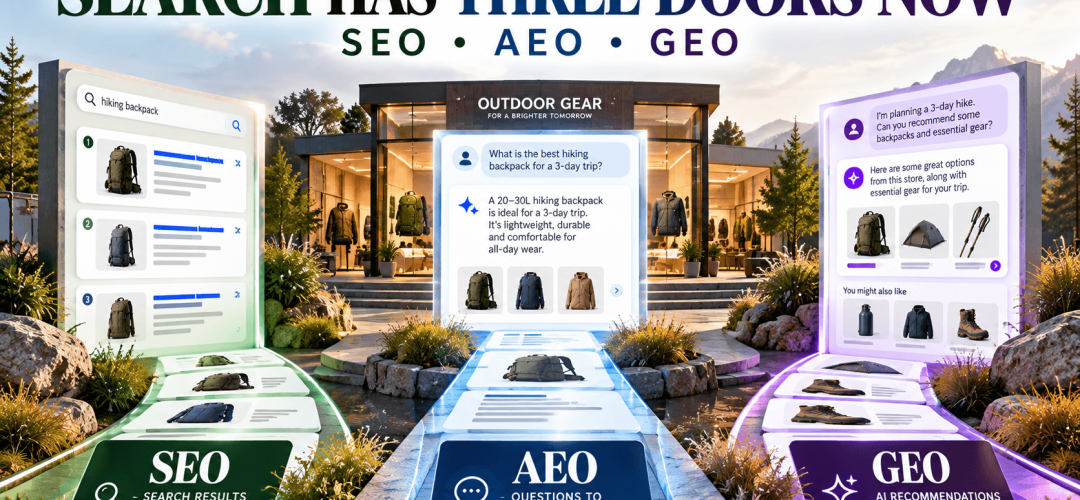
SEO helps your store rank in traditional Google search. AEO structures your content so AI tools can answer questions about your products directly. GEO builds your visibility inside generative search experiences like ChatGPT and Google AI Overviews. For ecommerce brands, SEO vs AEO vs GEO isn’t a choice between three separate strategies. They work best together.
You’ve probably heard SEO, AEO and GEO used like they’re interchangeable, or like you need to pick one. Most Shopify brands only realise the difference once it’s too late, usually after paying an agency for a ranking report that never turned into more orders. Meanwhile their traffic quietly shifts away from classic search results and into AI answers they can’t see or control.
If your organic traffic is thin and ads are doing the heavy lifting, that’s a second problem stacking on top of the first: turn the ad spend off and revenue drops with it. You don’t need three separate campaigns to fix both. You want your store to show up wherever your customers are searching, whether that’s Google, ChatGPT or Perplexity, as one traffic source you own instead of one you rent.
This guide breaks down what each term means, how they connect, and where to focus first.
Below, we’ll compare AEO vs SEO vs GEO side by side. We’ll show how they build on each other, and what each one looks like on real ecommerce pages. We’ll also cover how to measure results and which one to prioritise if you’re starting from scratch.
What Is the Difference Between SEO, AEO and GEO?
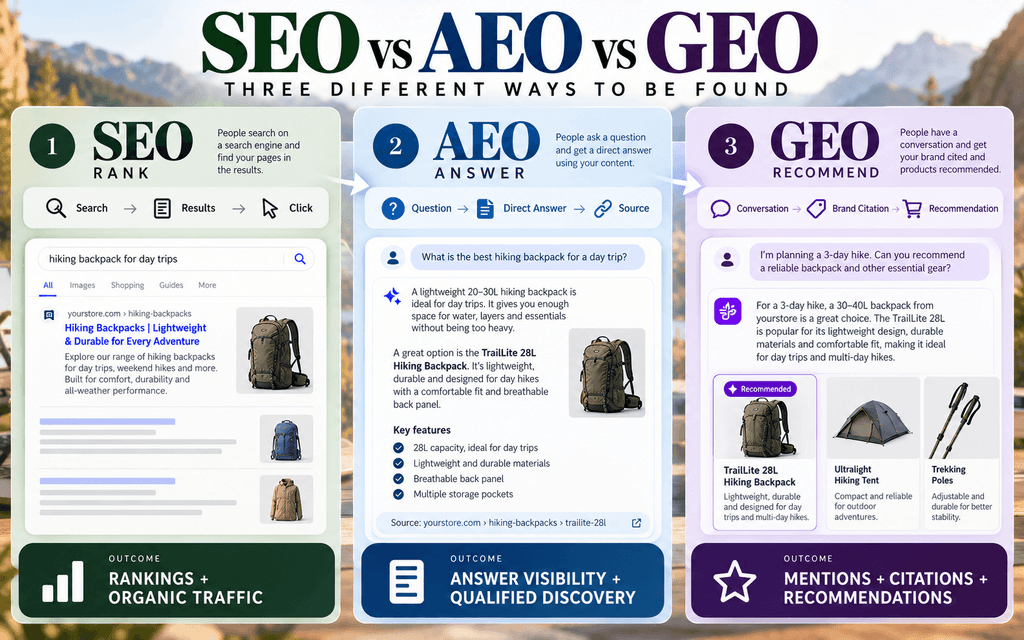
SEO optimises for traditional search rankings. AEO optimises for direct answers in AI tools. GEO optimises for visibility across generative search experiences. Each one targets a different way people now find products online.
What Is SEO?
SEO (search engine optimisation) is the practice of making your store easy for Google to crawl, index and rank. It covers site structure, page speed, content relevance and backlinks. These are the fundamentals that decide whether your products show up in organic search results.
What Is AEO?
AEO (answer engine optimisation) structures your content into clear, direct answers. AI tools like ChatGPT and Google AI Overviews can then pull that answer straight from your page. Instead of ranking for a keyword, you’re aiming to be the source an AI quotes. That happens when a shopper asks a question. That’s the goal of Answer Engine Optimization (AEO): making your content the one AI systems choose to quote.
What Is GEO?
GEO (generative engine optimisation) improves how your brand and products show up inside generative search environments. That includes the AI-written answers and recommendations in tools like ChatGPT Search, Perplexity and Gemini. Generative Engine Optimization (GEO) is less about ranking and more about being recognised, cited and recommended.
SEO vs AEO vs GEO: Side-by-Side Comparison
SEO vs AEO vs GEO comes down to this: here’s how the three compare across what matters most for ecommerce.
| Dimension | SEO | AEO | GEO |
| Primary goal | Get your store found | Get your content used as the answer | Get your brand recommended by AI |
| Search experience | Traditional search results pages | Answer boxes and AI Overviews | Conversational answers in ChatGPT Search, Perplexity, Gemini |
| Visibility outcome | Rankings and clicks (Search Console) | Answer placements and qualified referrals | Mentions, citations and recommendations |
| Measurement | Google Search Console, GA4 organic traffic | GA4 referral-source segmentation | Shopify’s attributed sales reporting |
Primary Goal
SEO goals, AEO goals and GEO goals aren’t interchangeable. Here’s what that looks like on a real store: a Shopify store selling hiking boots might rank third for “waterproof hiking boots.” It could get quoted by ChatGPT when someone asks which boots handle rain best. It might also get named when Perplexity recommends outdoor brands.
Search Experience
Traditional search and generative search feel like different worlds, but a shopper can hit all three without opening your site once. They scroll past your blue link on Google. They read your answer inside an AI Overview. Then they hear your brand named out loud in a ChatGPT conversation. Same product, three different screens.
Visibility Outcome
SEO delivers rankings and clicks you can track in Search Console. AEO delivers answer placements and qualified referrals. GEO delivers mentions, citations and recommendations inside AI answers. Pew Research found that only 8% of users click through when a summary appears, versus 15% without one. These outcomes still shape buying decisions, even without a click. At iWeb Power, AEO and GEO come as standard in our SEO retainers. We don’t sell them as a separate line item.
Optimization Focus
In practice, that means three different backlogs: a technical SEO checklist (site speed, internal linking, crawl budget), an AEO checklist (clear question-and-answer structure on the page), and a GEO checklist (explicit product, brand and attribute data an AI system can parse without guessing).
Measurement
SEO, AEO and GEO metrics don’t all come from the same dashboard. AI tools don’t always pass clean referral data the way Google Search Console does. AI search measurement is worth treating as its own line item, not an afterthought bolted onto your existing SEO report.
AEO vs SEO: What’s the Main Difference?
SEO vs AEO comes down to search visibility versus answerability: SEO gets your page found, AEO gets your content used as the answer. A product page can rank #4 for its main keyword and still never get pulled into an AI Overview, because ranking and answerability are graded on different things. SEO checks how findable a page is. AEO checks how clearly it answers one specific question. That’s the focus of our dedicated AEO vs SEO comparison.
Search Visibility vs Answerability
SEO vs AEO, search visibility vs answerability, in practice: search “your product + reviews” and see whether your page ranks. Then ask ChatGPT the same question and see whether it names you. A brand can pass one test and fail the other.
GEO vs SEO: What’s the Main Difference?
Rankings vs generative visibility is the core distinction behind GEO vs SEO for ecommerce brands. SEO focuses on organic search rankings. GEO focuses on whether your brand gets mentioned, cited or recommended inside generative AI answers, and that doesn’t always come from ranking first.
Rankings vs Generative Visibility
A page ranking #1 can still get skipped entirely when ChatGPT names three competitors instead. GEO visibility inside generative search depends on how clearly your entities, attributes and authority signals come through, not just your ranking position.
AEO vs GEO: What’s the Difference?
AEO vs GEO is a matter of scope, and this is the one pairing that doesn’t have its own dedicated comparison page because the overlap is this tight. AEO focuses on answering one specific question clearly. GEO covers the wider picture: how your brand, products and content show up across generative search overall.
Answers vs Generative Discovery
Answers vs generative discovery: a well-answered FAQ entry can win you a single citation. GEO is what determines whether that citation names your brand consistently across dozens of different AI conversations, not just the one you optimised for.
Where AEO and GEO Overlap
Both rely on the same AI search optimization foundations: clear entities, contextual relevance and direct information. The content also needs to be easy for AI systems to parse. Get these right and you build AEO and GEO visibility at the same time.
How Do SEO, AEO and GEO Work Together?
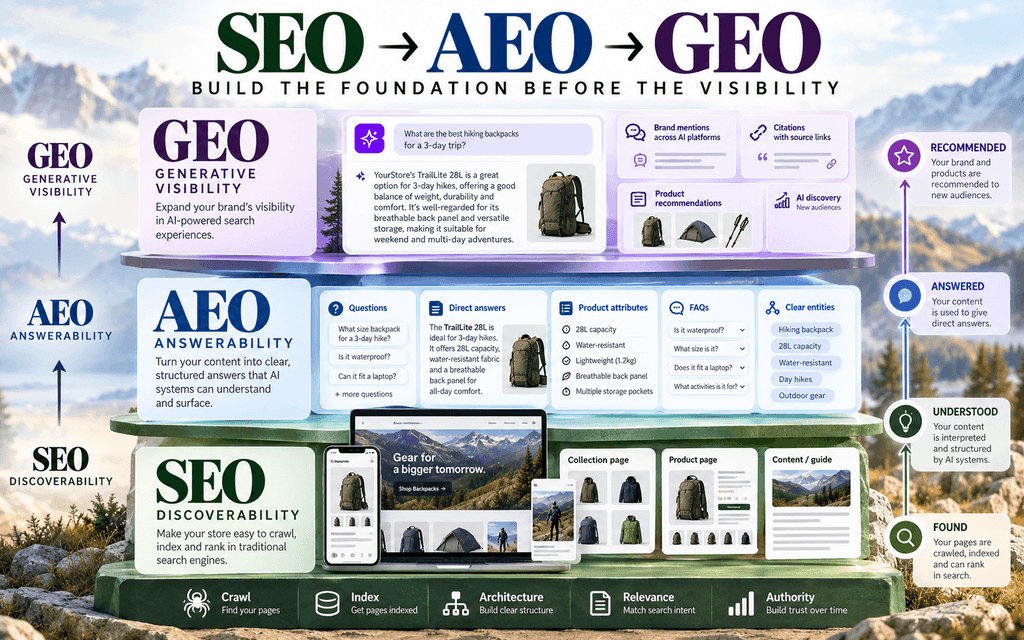
SEO, AEO and GEO aren’t three separate campaigns. They build on each other in this order:
SEO makes your pages crawlable, indexable and trustworthy enough for AI systems to use in the first place.
AEO structures that content into clear, extractable answers.
GEO builds the broader entity and authority signals that get your brand cited and recommended.
Skip the SEO foundation, and AEO or GEO work has nothing solid to build on. AI tools can’t cite a page they can’t crawl or trust.
SEO Builds Discoverability
SEO discoverability, meaning crawlability, site architecture, relevance and authority, creates the foundation every other layer depends on.
AEO Builds Answerability
Clear questions, direct answers and well-defined entities make your content easier for AI tools to understand and reuse.
GEO Builds Generative Visibility
GEO visibility comes from strong entity clarity and authority signals that extend into generative environments. That’s where AI recommends and cites brands, not just pages.
What Does SEO, AEO and GEO Look Like for Ecommerce?
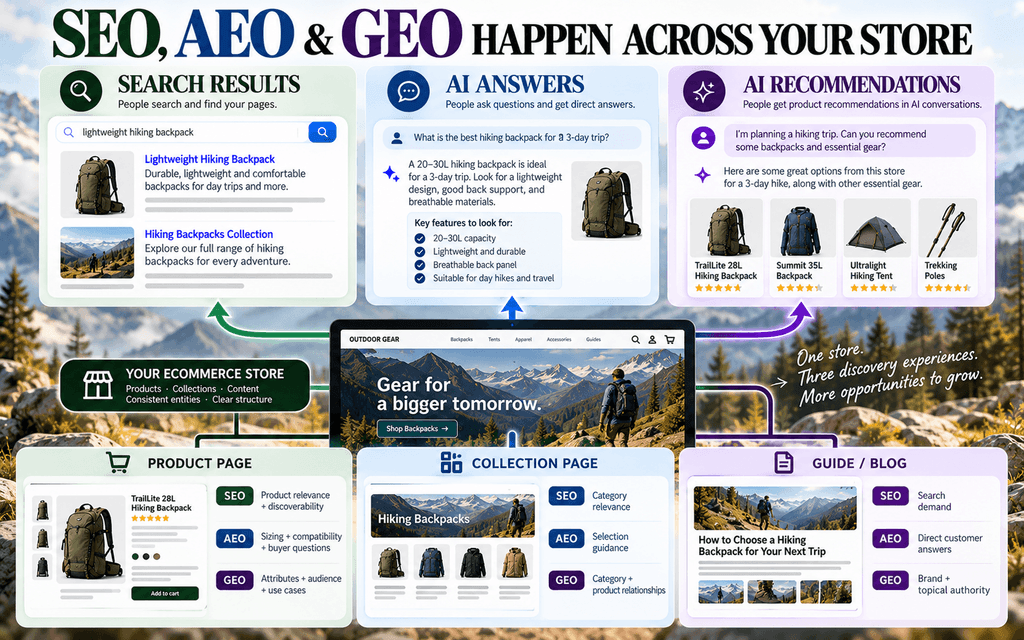
On a real Shopify store, all three show up differently depending on the page type. That’s where ecommerce AI search optimization becomes practical rather than theoretical.
Product Pages
One product page can support all three at once. SEO makes it findable, AEO answers buyer questions directly, and GEO makes the product’s attributes explicit. Often, all three draw on the same Product schema fields.
SEO: Product Relevance and Discoverability
Clear titles, relevant descriptions and clean technical structure make the product page easy to find and crawl.
AEO: Product Questions and Direct Answers
Answering real buyer questions, like sizing, compatibility and use cases, directly on the page helps. It gives AI tools something concrete to cite. Pull these questions from actual Search Console queries or support tickets, not guesses.
GEO: Product Attributes and Context
Explicit product attributes, audience and use cases, tagged clearly in your product data, help AI tools understand the product. They also show who it suits.
Collection and Category Pages
Collection pages set the topical and commercial context that ties individual products together, often reinforced with BreadcrumbList schema. This gives SEO, AEO and GEO a shared structure to work from.
Ecommerce Guides and Blog Content
Blog content should answer real customer questions while connecting naturally to the products and categories it supports. That makes it useful on its own, and useful to AI tools building context about your brand.
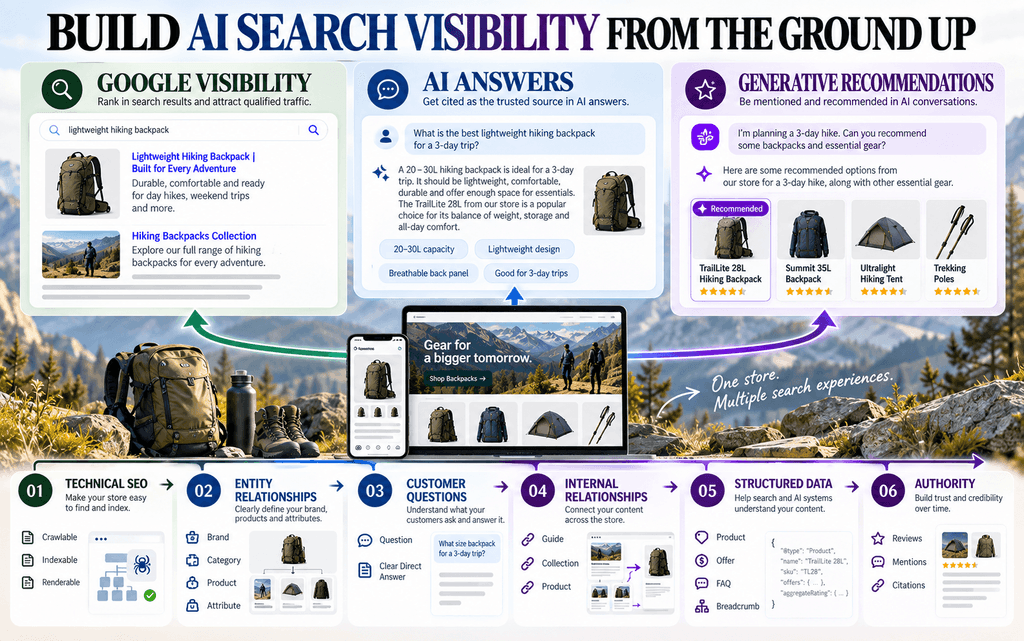
How Should Ecommerce Brands Optimize for SEO, AEO and GEO Together?
Here’s a practical AI search optimization framework. It starts with the foundation every other layer depends on.
Start With Technical SEO
Technical SEO starts with confirming your important pages are accessible and crawlable, including to AI crawlers like GPTBot, PerplexityBot and ClaudeBot. OpenAI’s own crawler documentation confirms GPTBot access is controlled through robots.txt. Check yours isn’t blocking it, and make sure key content renders without relying only on JavaScript.
Build Clear Entity and Attribute Relationships
This is semantic SEO: structure your data so the relationships between entities are obvious — Brand to Category to Product, and Product to Attribute to Value. A JSON-LD Product schema block that lists brand, category and key attributes gives AI systems exactly this.
Answer Important Customer Questions
Add real customer questions as short, direct answers throughout your site. Source them from Search Console queries, support tickets or People Also Ask results, not invented examples.
Strengthen Internal Relationships
Semantic internal linking means connecting informational content to the commercial pages it supports, using keyword-matched anchor text. These contextual links help both search engines and AI crawlers understand how your pages relate to each other.
Use Structured Data Where Relevant
Add Product, Offer, FAQPage and BreadcrumbList schema where they apply. This vocabulary is maintained jointly by Google, Microsoft, Yahoo and Yandex. It’s the shared standard AI systems and search engines rely on to read structured data consistently. Structured data won’t fix weak content on its own. That’s the real question behind schema markup for AI search. It makes good content easier for AI systems to parse, but it can’t replace the content itself.
Build Brand and Product Authority
Reviews, press mentions and third-party citations help AI tools corroborate claims about your brand. The more your brand gets mentioned independently, the more confidently AI systems can recommend it.
How Do SEO, AEO and GEO Affect ChatGPT Visibility?
ChatGPT Search draws on all three layers to decide what to show and cite. That’s the whole question behind how to rank in ChatGPT Search.
SEO Supports Discovery
Strong search discoverability means AI crawlers like GPTBot can find and access your content in the first place. If a crawler can’t render or index a page, AEO and GEO have nothing downstream to build on. There’s simply nothing left for ChatGPT to draw on.
AEO Supports Clear Answers
Content structured as clear, direct answers gives ChatGPT something concrete to quote when a shopper asks a related question. Vague or scattered answers force the model to guess or stitch fragments together. That makes your brand less likely to be the one it quotes.
GEO Supports Generative Brand and Product Visibility
Generative visibility on ChatGPT comes from clear entity and authority signals that increase the chance it mentions your brand by name, not just a generic product category. Without those signals, ChatGPT can’t tell your product apart from a dozen similar ones. It defaults to describing the category instead of naming you.
How Do SEO, AEO and GEO Affect AI Product Recommendations?
The same three layers decide whether AI tools recommend your products at all. That’s exactly the challenge brands face when they want to get ecommerce products recommended by AI.
SEO Helps Products Become Discoverable
Without solid product and category SEO, AI tools have no reliable way to find your products in the first place.
AEO Clarifies Product Suitability
Clear answers about compatibility, use cases and sizing help AI tools judge product suitability against the right buyer question. Without that clarity, the AI can’t tell whether your product fits. It recommends a competitor’s listing instead.
GEO Connects Products With Generative Recommendation Contexts
Explicit product attributes and audience signals improve your eligibility for AI recommendations. No agency can guarantee a specific AI placement, but strong GEO foundations make it far more likely.
Which Is More Important: SEO, AEO or GEO?
If you’re asking SEO vs AEO vs GEO which is better, the honest answer for most established ecommerce brands is: none of them wins outright. How much each one matters shifts depending on what’s already solid. They’re complementary layers. GEO investment underperforms without a strong SEO foundation, since there’s nothing reliable for AI to cite. AEO investment underperforms without SEO indexing behind it, for the same reason.
When SEO Should Be the Priority
Make SEO priority number one if crawlability, site architecture or organic visibility are weak. Check that key pages aren’t blocked in robots.txt for AI crawlers like GPTBot, PerplexityBot, ClaudeBot and Google-Extended. Also confirm your content renders without depending only on JavaScript.
When to Add AEO
Add AEO once your technical foundation is solid and customer questions, comparisons and purchase decisions matter to your category.
When to Expand Into GEO
Expand into GEO once your brand and product information is mature enough to support broader generative visibility. That means reviews, schema and entities are already clearly defined.
Does AEO or GEO Replace SEO?
No, AEO and GEO don’t replace SEO. They depend on it. Without solid technical and organic-search foundations, crawlers like GPTBot and ClaudeBot have nothing reliable to crawl, trust or cite. Talk of the future of SEO being over misses the point: SEO is still the ground floor everything else is built on.
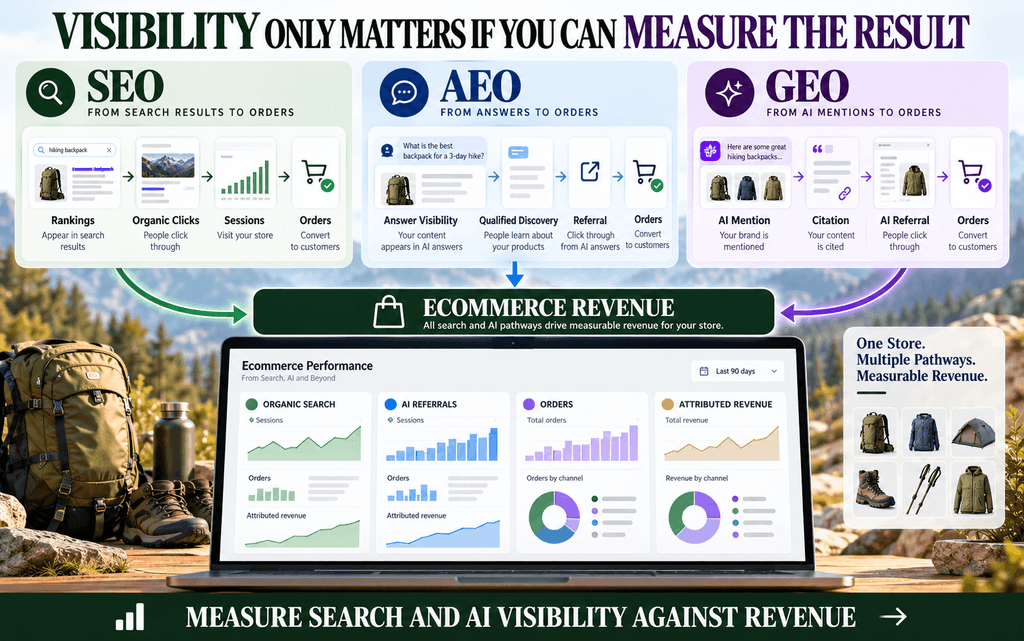
What Should an Integrated SEO, AEO and GEO Strategy Measure?
These metrics only earn their keep when you tie them back to revenue, not just visibility. Measuring AEO and GEO is newer and messier than classic analytics, so track each layer separately below, then roll them into one view of AI search ROI.
SEO: Organic Visibility, Traffic and Revenue
SEO metrics start with organic rankings, traffic and the revenue it drives, tracked using Google Search Console and GA4.
AEO: Answer Visibility and Qualified Discovery
AEO metrics track answer-oriented appearances where you can observe them, along with the traffic and conversions that follow.
GEO: Mentions, Citations, AI Traffic and Revenue
GEO metrics track AI referral traffic through GA4 referral-source segmentation, alongside Shopify’s attributed sales reporting for AI-referred revenue. This is where our Shopify-attributed organic and AI-referred revenue reporting comes in. You see what’s converting, not just what’s ranking.
SEO vs AEO vs GEO: Which Strategy Should Your Ecommerce Brand Use?
Most established ecommerce brands need all three, working as one integrated strategy.
| Your situation | Priority |
| Crawlability, architecture, or organic rankings are weak | Fix SEO first |
| Technical foundation is solid; buyers ask comparison/purchase questions | Add AEO |
| Brand and product data are mature; reviews and schema are in place | Expand into GEO |
| All three are already weak | Build them together under one team, not three separate vendors |
SEO is the foundation, AEO handles answerability, and GEO drives broader generative discovery. Treating them as separate campaigns wastes budget. Treating them as layers of the same strategy builds visibility everywhere your customers are searching.
Frequently Asked Questions
A few frequently asked questions (FAQ) that come up once brands understand SEO, AEO and GEO aren’t three separate line items.
Is AI Search Optimization Sold Separately, or Built Into an SEO Retainer?
AI search optimization pricing at iWeb Power isn’t quoted as an AEO GEO separate service: AEO and GEO are built into your SEO retainer by default. You get one combined SEO strategy cost across Google and AI search, not three separate invoices.
What Should You Budget for a Combined SEO, AEO and GEO Strategy?
Your combined AI search strategy cost should be budgeted as one integrated retainer rather than three separate services. Costs vary by store size and competition. But combining SEO, AEO and GEO under one team is typically more cost-effective than running them as separate projects. It also avoids duplicated work.
Build an Ecommerce Search Strategy for Google and AI
Ready to stop guessing where your customers are finding you? One AU-based Shopify camping-gear brand’s own backend attribution went from $3K a month in ad spend to $82K in attributed organic sales after we rebuilt their SEO, AEO and GEO foundation. We build the same SEO, AEO, and GEO services for ecommerce for Shopify brands: Google rankings, AI answers and generative recommendations under one team, with Shopify-attributed revenue reporting so you see what’s actually working. Book a free audit to see where your store stands today.
