
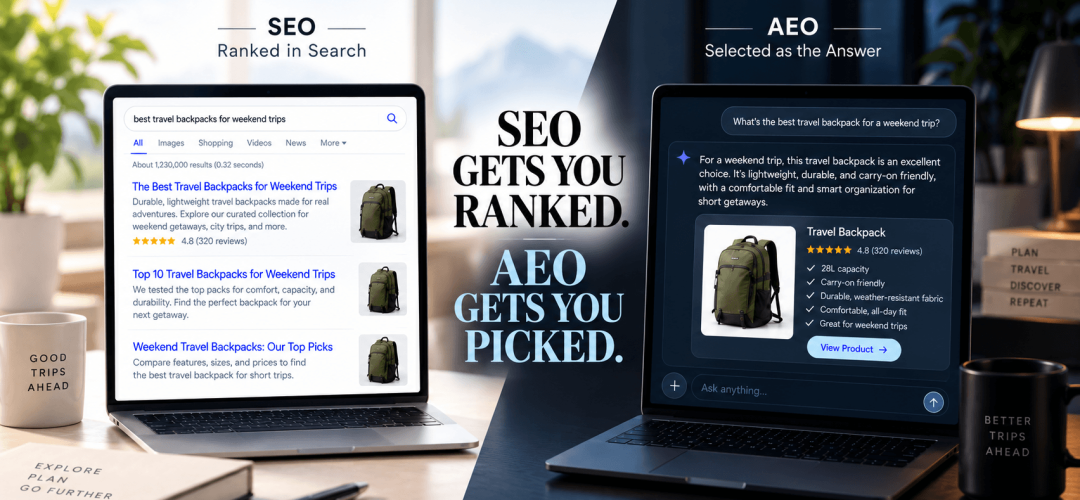
If your content isn’t built to be pulled apart and quoted, ChatGPT and Google AI Overviews will still answer your customer’s question. They’ll just use someone else’s page to do it. SEO gets your store ranked. AEO gets your content picked as the answer. AEO and SEO aren’t competing systems, and most ecommerce brands need a strong SEO foundation first, then AEO layered on top.
You’ve probably typed a question straight into ChatGPT Search, Perplexity, or Google AI Overviews lately and gotten a full answer without clicking a single link. That same shift is playing out across Gemini, Claude, and Microsoft Copilot too, and it’s quietly changing how Shopify brands get found online. Ranking on page one isn’t enough anymore if your content never gets pulled into the answer itself.
The real change isn’t choosing between SEO and something new. It’s understanding how AEO vs SEO now work side by side, and it isn’t just another vanity metric to report on. Our take: a report that only shows rankings doesn’t tell you if it made money, and the same standard now applies to AI-driven visibility.
This guide breaks down what each one optimises for, and how to decide where ecommerce AEO fits into your existing strategy. If you’ve typed the answer engine optimization vs SEO question into Google, this is the practical version, not the theory.
What Is the Difference Between AEO and SEO?
The difference between AEO and SEO comes down to what each one is optimising for. SEO optimises your store to rank higher in traditional search results and earn organic clicks. AEO optimises your content so an AI system can lift it out and use it directly as an answer. Once you see the AEO SEO difference this way, the two stop looking like rivals. AEO vs SEO becomes two goals working toward the same outcome: getting found.
What Does SEO Optimize For?
SEO, short for search engine optimization, is built around getting your pages found, understood, and trusted by search engines. For ecommerce SEO specifically, that means:
- Crawlability and a clean site structure
- Relevance to search intent and target keywords
- Authority signals like backlinks and reviews
- Organic search rankings that drive qualified traffic
Get these right and your store shows up higher in organic search for the terms your customers already use.
What Does AEO Optimize For?
AEO, or answer engine optimization, is built around clarity. It asks whether an AI system reading your page could lift out a clean, accurate answer without extra work.
That kind of answer optimization means writing direct answers, defining terms plainly, and organising each section around one clear question. In short, what is Answer Engine Optimization (AEO) comes down to writing for the question, not just the keyword.
AEO vs SEO: How Do They Compare?
The AEO vs SEO comparison isn’t a rivalry, not once you line them up. Weigh SEO vs AEO attribute by attribute, and the picture gets clear fast. The answer engine optimization vs SEO question just comes down to what each one measures, not who wins:
| Dimension | SEO | AEO |
| Competes for | A spot in the search rankings | The single direct answer the system hands back |
| Optimizes | Keywords and search intent | Explicit questions behind that intent |
| Measured by | Organic clicks | Answer visibility and citations |
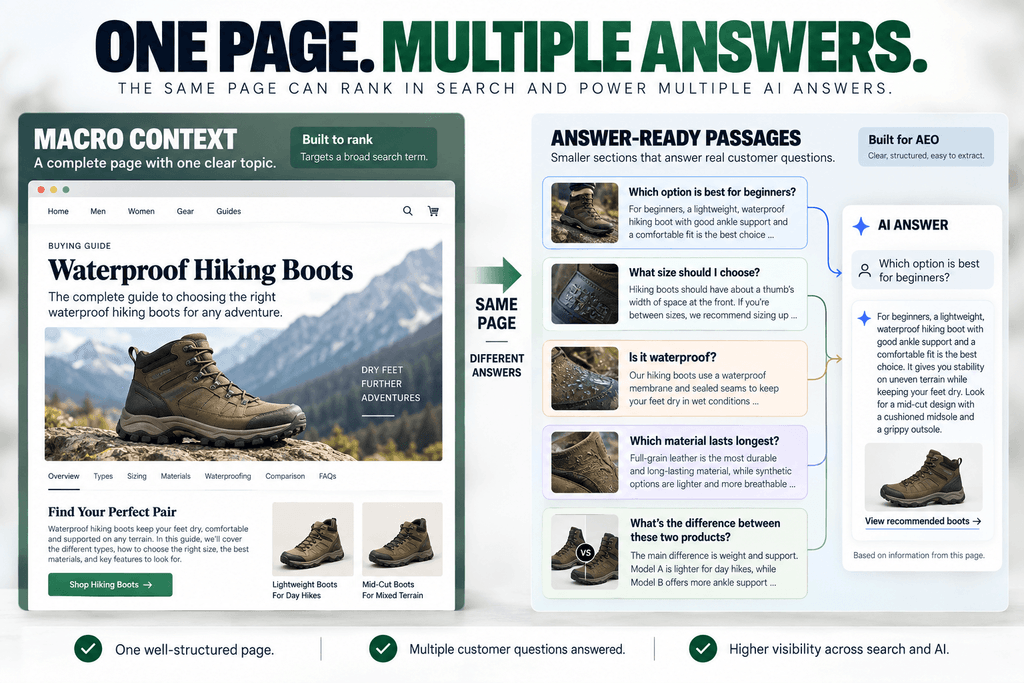
| Structured around | A page built to rank | A Macro Context page holding answer-ready passages |
Search Rankings vs Direct Answers
SEO competes for a spot among the search rankings. AEO competes to be one of the direct answers that answer engines hand back. Both still depend on relevance and authority. Only AEO also demands that the answer sit in a form the system can lift out cleanly.
Keywords vs Questions and Search Intent
SEO and AEO both need a clear read on search intent, but when you weigh keywords vs questions, AEO puts more weight on the explicit answer queries behind that intent. Writing to “best running shoes for flat feet” now means answering that exact question, not just working the phrase into a paragraph.
Search Result Clicks vs Answer Visibility
Organic traffic and answer visibility aren’t the same outcome, and the two are already pulling apart. Pew Research found that people click a traditional search result in just 8% of visits when an AI summary is present, compared with 15% when it isn’t, though Google has disputed the study’s methodology as unrepresentative of search traffic overall. Directionally, though, the trend lines up with what most SEO teams are already seeing: your store can still show up as a cited answer and earn a click when the reader wants more detail, but you can’t rely on the click alone to prove your AEO visibility.
Pages vs Answer Passages
A page still needs a clear overall purpose, its Macro Context. Inside that page, individual answer passages can each answer a specific Micro Context question. That’s the structural shift good AEO content makes: a collection page can hold one clear purpose while still answering five different customer questions section by section.
How Do SEO and AEO Work Together?
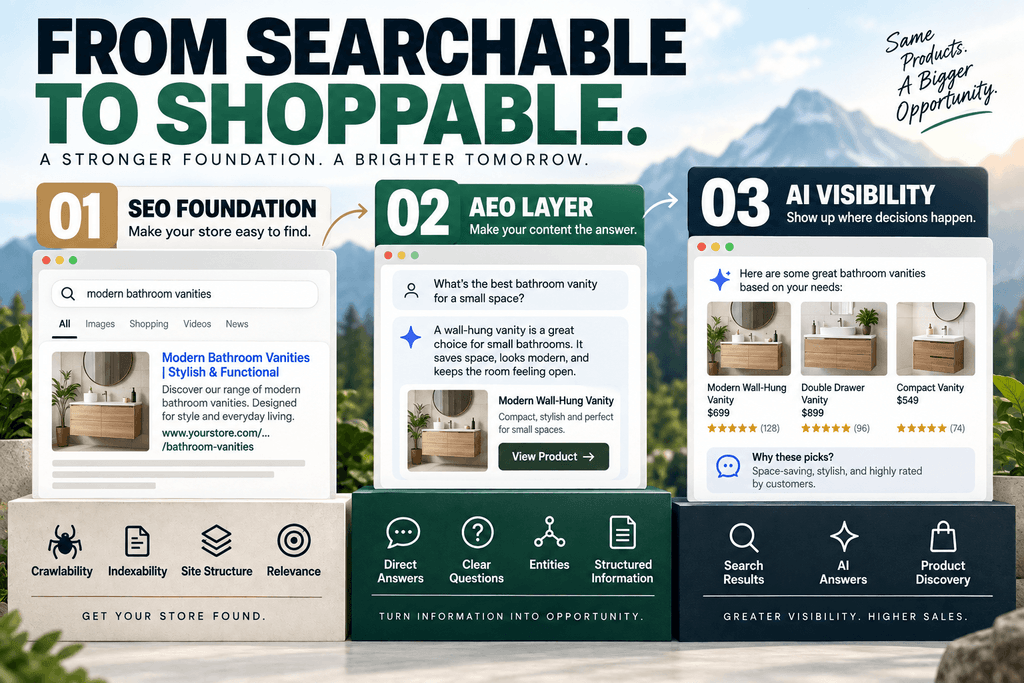
AEO isn’t a replacement for SEO. It’s a layer that sits on top of a strong SEO foundation, and a solid AEO SEO strategy treats SEO and AEO as connected, not competing. Here’s how the two connect, in three steps: (1) SEO makes your content discoverable, (2) AEO makes it usable as an answer, and (3) both draw on the same underlying semantic signals.
SEO Helps Search Systems Discover and Understand Your Content
Technical SEO does the groundwork AEO depends on. Before you touch content, confirm that AI crawlers like GPTBot, PerplexityBot, ClaudeBot, and Google-Extended aren’t blocked in your robots.txt, which they’re required to respect. You can also add an llms.txt file if you want to signal preferences to these systems directly, though it’s a community convention rather than a confirmed standard, so treat it as a nice-to-have, not a guarantee any AI provider will read it. From there:
- Crawlability, so systems can reach your content at all
- Indexability, so it’s eligible to appear anywhere
- A clear site architecture and internal linking
- Semantic SEO signals strong enough that the topic is unambiguous
AEO Makes Information Easier to Extract as an Answer
Once content is discoverable, this kind of answer optimization makes it usable as an answer:
- Direct responses to specific questions
- Clear, upfront definitions
- Obvious question-and-answer relationships
- Supporting evidence and context nearby
For example, a page selling hiking boots that states outright “true to size, but order half a size up for thick socks” gives an AI system a cleaner answer than five paragraphs of brand story.
AEO and SEO Share Semantic Signals
Both disciplines lean on the same underlying semantic SEO signals: entities, attributes, intent, contextual relevance, structured information, and authoritative content. That overlap is the whole AEO SEO relationship in miniature: strengthen one and you usually strengthen the other.
Why Does AEO Matter for Ecommerce?
Shoppers ask a lot of specific questions before they buy. AEO for ecommerce, or ecommerce AEO, is about making sure your store can answer them, and it also gives you a visibility channel that isn’t dependent on rising ad costs or a single platform’s algorithm.
Ecommerce Searches Often Require Direct Answers
Think about the product questions a shopper types or speaks:
- Does this fit a size 10 foot?
- Is this compatible with my existing setup?
- What’s it made from?
- How long does shipping take?
- Which option suits my situation best?
Each one has a specific, factual answer. Ecommerce AEO is about making sure that answer is easy to find on your site.
AEO Can Support Product Discovery and Research
Shoppers researching a product often ask AI tools before they visit any store. Someone typing “best backpacking stove under 100g” into ChatGPT is deciding what to buy before they’ve searched Google at all. This is exactly where ecommerce AI search optimization comes in: good ecommerce AEO gives your content a better chance of being part of that product discovery and research process, well before a shopper lands on your site.
AEO Can Support Commercial Search Journeys
Informational answers don’t need to turn into a sales pitch to be useful. A clear, honest answer about product fit or use case can still lead a shopper toward a category or product page when they’re ready. This is where AEO supports the wider commercial search journey rather than forcing it.
What Ecommerce Content Should You Optimize for AEO?
Not every page needs the same treatment. Some page types carry far more AEO content opportunity than others.
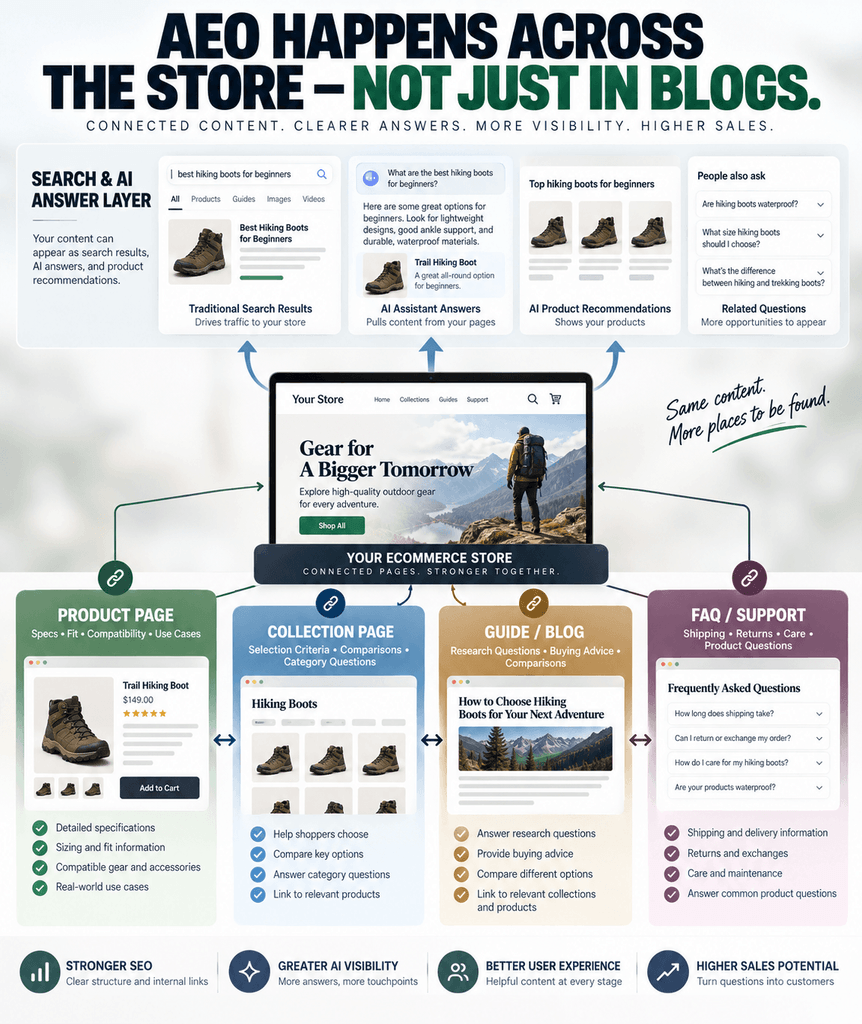
Product Pages
Product pages answer specific product questions about a single item, so product page AEO starts here.
Product Features and Specifications
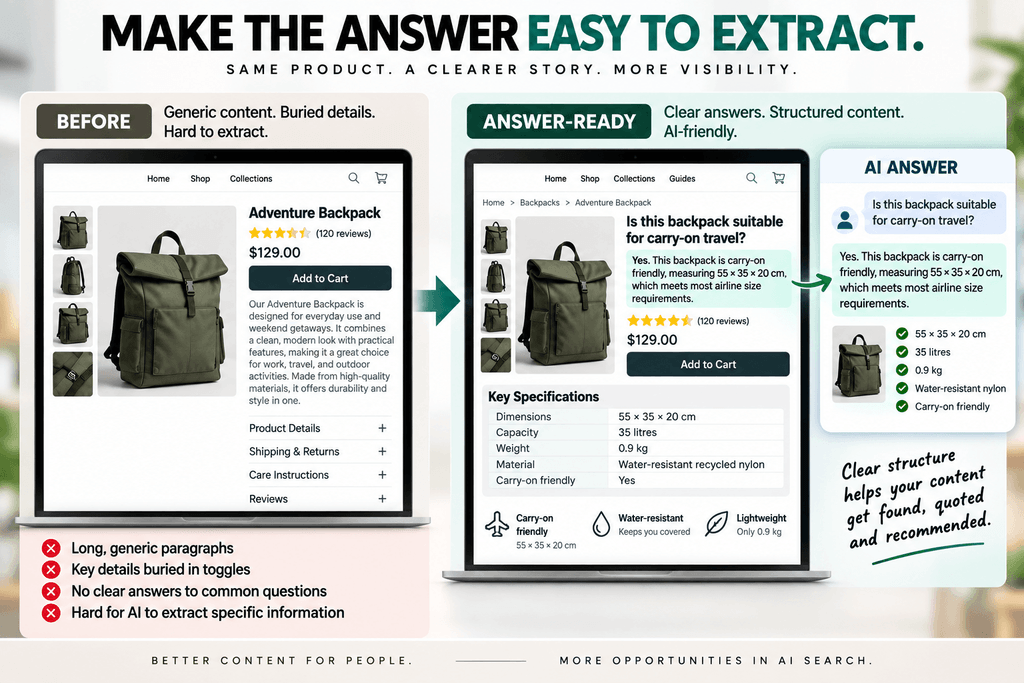
Make factual product attributes explicit using spec tables and the actual attribute-value pairs a buyer would compare, like weight, dimensions, and material, not marketing adjectives. Clear product specifications mean a reader never has to infer the dimensions, materials, or capacity from a photo.
Product Use Cases and Suitability
Answer the product questions that decide fit: who the product is for, what problem it solves, and when it’s the right choice. Product suitability, not just specs, is what gets a shopper to add to cart.
Collection and Category Pages
Collection page SEO can answer broader category questions while still helping with product discovery, which is the core of category page AEO. Facets and filters, like size, material, or price range, should map to real selection criteria, not just navigation.
Category Definitions and Selection Criteria
Explain what the category is and which buying criteria shoppers should weigh up before choosing.
Product Comparison Questions
Product comparison questions are what shoppers ask naturally during product selection within a category. Pull these from Search Console queries, support tickets, or “People Also Ask” boxes rather than inventing them, since AI engines reward genuine question-intent matches over generic ones.
Guides and Educational Content
Supporting ecommerce guides answer research-stage questions and connect them back to the commercial pages they support.
FAQs and Customer Support Content
Ecommerce FAQs are useful when they answer real customer questions. AEO isn’t about bolting an FAQ section onto every page. It’s about answering the right question in the right place, whether that’s a product page, a category page, or a dedicated FAQ.
How Do You Optimize an Ecommerce Website for AEO?
Here’s a practical framework for how to optimize for AI search engines across your ecommerce site:
1. Identify the questions customers actually ask
2. Give the direct answer first
3. Keep each page focused on one Macro Context
4. Strengthen entity and attribute relationships
5. Add relevant structured data
6. Build contextual internal links
Identify the Questions Customers Actually Ask
This is the core of AEO keyword research: map real customer questions, sourced from Search Console queries, support tickets, or People Also Ask boxes, to search intent, customer problems, products, and buying stages. Don’t invent arbitrary FAQ content just to fill a section.
Give the Direct Answer First
Lead with answer-first AEO content, then follow with explanation, evidence, or examples. Direct answers belong in the first sentence, not buried under three paragraphs of setup.
Keep Each Page Focused on One Macro Context
This is where topical relevance and contextual SEO meet: a page should have one clear dominant purpose, with related semantic content acting as Micro Contexts underneath it.
Use H2s for Major Questions and Attributes
Organise the primary supporting contexts beneath the page’s main topic using H2 headings, following the same content hierarchy logic as H2 SEO best practice.
Use H3s and H4s for Supporting Details
Expand subordinate attributes and processes with H3 and H4 headings as part of the wider content structure, but only when they genuinely support the parent context. A shallow, logical heading hierarchy is easier for both readers and AI systems to follow than a flat wall of H2s.
Strengthen Entity and Attribute Relationships
This is entity SEO in practice: connect products, brands, categories, product attributes, problems, and use cases through explicit, stated semantic relationships rather than assuming a reader will infer them.
For example, a camping stove listed under a brand, inside a “backpacking stoves” category, with a stated weight, fuel type, and boil time, gives an AI system a clear chain to work from: brand to category to product to attributes. A simple JSON-LD snippet can make that chain explicit:
{
“@type”: “Product”,
“name”: “Example Backpacking Stove”,
“brand”: { “@type”: “Brand”, “name”: “Example Brand” },
“additionalProperty”: [
{ “@type”: “PropertyValue”, “name”: “Weight”, “value”: “85g” },
{ “@type”: “PropertyValue”, “name”: “Fuel Type”, “value”: “Canister” }
]
}
Add Relevant Structured Data
Schema markup for AI search can reinforce information that’s already explicit on the page, when you use the right type for the job: Product and Offer schema for pricing and availability, FAQPage schema for question-and-answer content, BreadcrumbList for site structure, and Organization schema for brand-level details. Google’s own documentation is explicit that marking up a page correctly does not guarantee it will show up with a rich result. The same logic extends to AI answers: schema reinforces what’s already clear on the page, it doesn’t manufacture visibility from nothing.
Build Contextual Internal Links
Google’s own Search Central guidance states that every page you care about should have a link from at least one other page on your site, since Google uses links to find new pages and judge relevance. This kind of contextual internal linking connects readers, and search systems, to more specific or commercially important pages nearby, like the ones on product discovery, schema markup, and measuring AI search performance covered elsewhere in this series.
Does AEO Help With AI Search Visibility?
AEO can support broader AI search visibility, but it isn’t the only factor that determines whether your brand shows up in a generative answer. That broader shift is what Generative Engine Optimization (GEO) is all about.
How AEO Supports Machine Understanding
Clear questions, answer content, entities, and attributes all reduce ambiguity about what a page is about. That’s what builds real machine understanding.
AEO vs GEO: Where Do They Overlap?
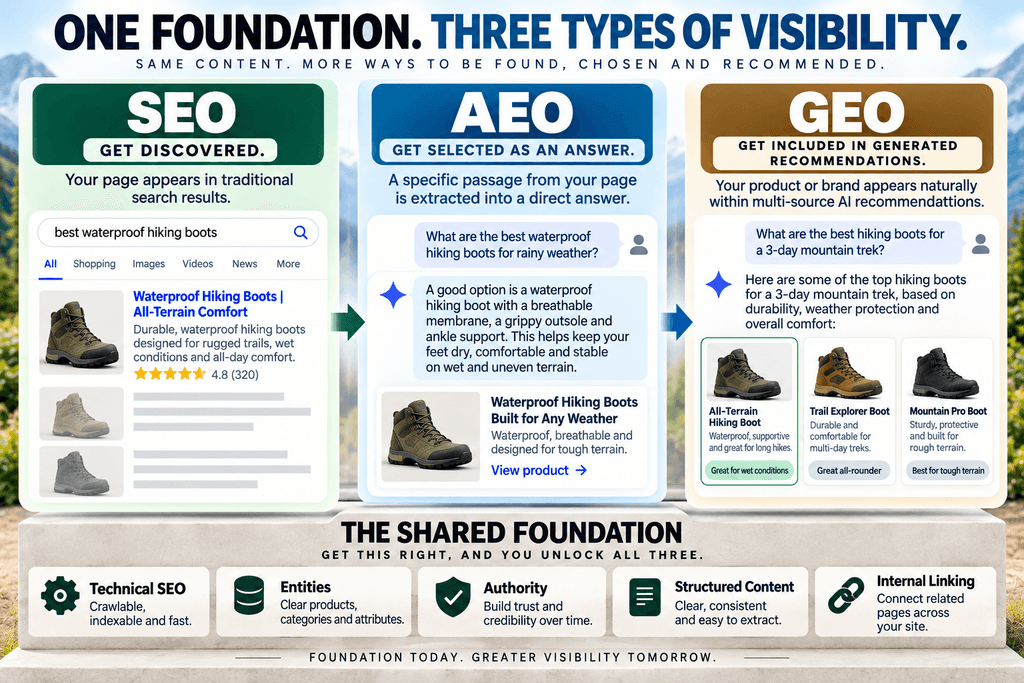
AEO vs GEO comes down to this: AEO focuses on answerability, GEO focuses on visibility inside generative search experiences. They share a lot of the same underlying principles, and the quickest way to see the overlap is side by side:
| Dimension | AEO | GEO |
| Optimizes for | Content an AI system can lift out as a direct answer | Visibility inside a generative, synthesized response |
| Depends on | Clear questions, definitions, entities | The same signals, plus broader authority and citation patterns |
| Shows up in | A single quoted answer or FAQ snippet | A generated summary pulling from multiple sources |
Looking at GEO vs SEO side by side makes that overlap easier to see too.
How Is AEO Different From GEO?
In short: the AEO vs GEO question comes down to focus. AEO centres on making your content answerable. GEO centres on your visibility inside generative AI experiences more broadly. They’re closely related, but they’re not the same discipline.
When Should Ecommerce Brands Use AEO and GEO Together?
Brands chasing visibility across conventional organic search, direct answers, and generative search results typically need AEO and GEO working together, not one instead of the other.
Can AEO Help Ecommerce Brands Appear in ChatGPT Search?
Answer-friendly content can support a broader ChatGPT Search optimization strategy, whether a shopper encounters your products through a standard ChatGPT Search result or through the shopping features built into ChatGPT. OpenAI’s crawler, GPTBot, needs to be able to access your site for any of this to matter in the first place, though none of it guarantees placement on its own. Understanding how to rank in ChatGPT Search is what moves the needle for ecommerce brands here.
How Do AEO and GEO Affect Product Recommendations?
When your product information is clear, well-structured, and easy to relate to specific attributes and use cases, AI tools have an easier time making product recommendations. This is where AEO and ecommerce GEO meet, and it’s exactly how brands get ecommerce products recommended by AI in the first place.
How Do You Measure AEO Performance?
AEO performance shouldn’t be judged on AI search visibility alone, and it shouldn’t be measured in the abstract either. Good AEO metrics track it with the same tools you’d use for organic performance: GA4 referral-source segmentation to separate AI-referred sessions from regular organic traffic, Google Search Console for query and impression data, and UTM parameters where you can add them to any citations you control. That’s exactly why you need to measure AI search visibility, traffic and revenue together, rather than chasing one number in isolation.
Track Answer and Search Visibility
Monitor answer visibility and search visibility together: where your content appears in answer-style results, which queries or topics it’s showing up for, and whether your AEO visibility is trending up or down over time.
Track Organic and AI-Referred Traffic
Where referral data is available, connect that visibility to measurable organic traffic and AI-referred traffic on your site using GA4’s referral-source segmentation.
Track Conversions and Revenue
Bring the measurement back to conversions and revenue: track AI-referred revenue against organic revenue side by side, using Shopify’s own attributed sales reporting alongside GA4, the outcomes that matter commercially, not visibility for its own sake.
Should Ecommerce Brands Prioritize AEO or SEO?
For most established ecommerce brands, AEO or SEO isn’t an either/or decision. Prioritisation should depend on your technical foundations, search demand, content quality, and where the real business opportunity sits.
Start With a Strong SEO Foundation
Accessibility, site architecture, relevance, and authority remain foundational. That’s the SEO foundation good ecommerce SEO builds on, and AEO doesn’t work well on top of a broken technical SEO base.
Layer AEO Into High-Value Customer Questions
Once the foundation is solid, prioritise the questions tied to products, collections, comparisons, and buying decisions, sourced from real Search Console queries, support tickets, or People Also Ask data rather than a generic list. This is where AEO for ecommerce pays off: you don’t need to optimise for every conceivable question, just the ones that matter to your buyers.
Expand Into GEO for Generative Search Visibility
From there, ecommerce GEO completes the progression, extending your visibility from conventional search and direct answers into generative search experiences.
Frequently Asked Questions
A quick FAQ covering the frequently asked questions that tend to come up once AEO and SEO are on the table together.
Is AEO Sold as a Separate Service, or Included in an SEO Retainer?
No, in most solid AEO and SEO partnerships it isn’t sold as a bolt-on. AEO and GEO should be included by default as part of an SEO retainer, not billed as a separate service, since they draw on the same technical foundation, content, and entity work.
Is AEO an Extra Line Item, or Does It Come Bundled With SEO?
It should come bundled, not appear as an extra line item on your invoice. If a quote lists AEO cost as a separate add-on, that’s worth asking about directly, since the work overlaps closely enough with SEO that treating it as a separate product rarely reflects how the work gets done.
Want to Improve Your Ecommerce Visibility Across Search and AI Answers?
SEO, AEO, and GEO aren’t three separate projects. AI search optimization for ecommerce, whether that’s AEO for ecommerce or ecommerce GEO, is one strategy for helping shoppers find your store, whether they’re scrolling search results, asking ChatGPT, or getting a direct product recommendation from an AI shopping assistant.
Paid ads stop producing the moment you stop paying for them. Organic sessions we drive for clients keep converting the month after, with zero incremental spend, that’s the number we put in your monthly report next to your Shopify-attributed revenue, not a ranking screenshot. At iWeb Power, AEO and GEO are included by default in our Shopify and Shopify Plus SEO retainers, not sold as an upsell. You get the same specialist on your account from day one, month-to-month terms with no 12-month lock-in, and reporting that ties organic and AI-referred traffic back to actual Shopify-attributed revenue, not just rankings. We also work with a number of Chinese cross-border ecommerce brands expanding into new markets, supported by a bilingual English/Mandarin team.
If you want a clear picture of where your store stands across search and AI answers, check our AEO and GEO services for ecommerce, or book a free 30-minute session to talk through your store specifically.
