
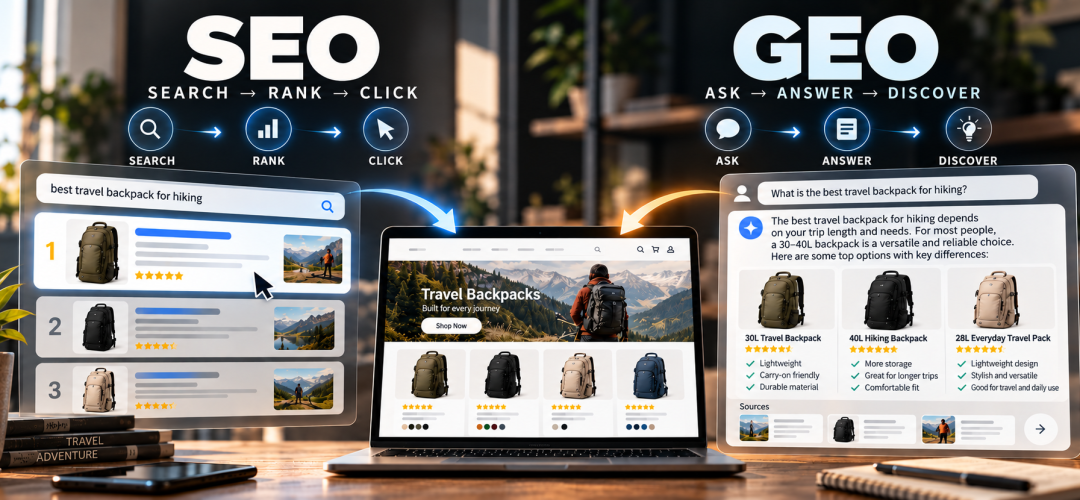
If your Shopify store already ranks well and your organic traffic has plateaued anyway, GEO is probably why. SEO improves your visibility in traditional search results. GEO improves how AI tools like ChatGPT, Perplexity, and Google AI Overviews understand and mention your brand. The core geo vs seo difference: SEO targets ranked results, GEO targets generative answers. Ecommerce brands need both working together, not one instead of the other.
More shoppers now ask ChatGPT or Perplexity to recommend a product before they open Google. Many store owners only notice this shift after their organic traffic plateaus, even with strong rankings. What most people want is simple: to be found, no matter which tool a customer uses. Understanding GEO vs SEO shows you where your current SEO work already helps, and where you need something more. This guide walks through the real differences between SEO and GEO, and how ecommerce brands can use both together.
We’ll break down what SEO and GEO each optimise for, show where AEO fits in, and cover how to measure results from both. You’ll also see a practical framework for combining all three so your store stays visible everywhere customers search.
What Is the Difference Between GEO and SEO?
The geo vs seo split comes down to what each system rewards. SEO optimises your store for traditional search engines like Google, focusing on rankings, clicks, and organic traffic. GEO optimises your brand and product information for generative search tools like ChatGPT, Perplexity, and Google AI Overviews, focusing on being mentioned, cited, or recommended.
What Does SEO Optimize For?
SEO optimises for crawlability, indexability, and relevance, so Google can find and rank your pages. It also targets authority signals like backlinks and site structure. The goal is more qualified organic traffic and higher rankings for the keywords your customers search.
What Does GEO Optimize For?
Generative Engine Optimization (GEO) optimises for how clearly AI tools like ChatGPT Search, Perplexity, Google AI Overviews, Gemini, and Claude understand your brand and products. It focuses on accurate information, clear entity relationships, and content AI models can cite with confidence. That’s what builds generative search visibility over time. At iWeb Power, AEO and GEO are included in every SEO retainer, not sold as a separate upsell.
GEO vs SEO: How Do They Compare?
Here’s how SEO and GEO compare across the areas that matter most for ecommerce.
| Dimension | SEO | GEO |
| Ranking vs visibility | Ranked position on a results page | Mentioned or recommended inside an AI-generated answer |
| Traffic signal | Click-through from a search result | Referenced inside an AI response, sometimes without a click |
| What it matches on | Keywords, to match search intent | Entities: brand, product attributes, relationships |
| Output format | A list of ranked links | One synthesised answer, often pulling from several sources |
Search Rankings vs Generative Visibility
Search rankings show where your page lands on a results page. Generative visibility shows whether an AI tool mentions or recommends your brand inside its answer. Both matter, but they’re measured in different ways. Track both, since AI search visibility and ranking position now move independently of each other.
Organic Clicks vs Mentions, Citations and Recommendations
Organic clicks happen when a shopper clicks through from a search result to your store. Mentions, citations, and AI recommendations happen when an AI tool references your brand or product inside its response, sometimes without any click at all. This is why GEO needs its own way of measuring success.
Keywords vs Entities, Attributes and Context
SEO still relies on keywords to match search intent. GEO relies more on entities: your brand name, product attributes, and how they relate to each other. Clear entities help AI models understand exactly what you sell and who it’s for. This shift toward entity relationships is often called semantic SEO, and it’s the groundwork GEO builds on.
Search Results vs AI-Generated Answers
Traditional search results return a list of ranked links for a shopper to choose from. Generative search returns one synthesised answer, often pulling from several sources at once. Your store can still be one of those sources, even without a top-three ranking.

How Do GEO and SEO Work Together?
SEO and GEO work together in a clear sequence. This is what GEO SEO integration looks like in practice:
- Build technical SEO foundations so your site is crawlable and indexable.
- Strengthen brand and product entities so AI tools understand what you sell.
- Publish accurate, trustworthy content that both search engines and AI models can rely on.
- Extend that same foundation into generative search visibility with GEO. GEO doesn’t replace SEO. It builds on it.
SEO Makes Ecommerce Content Discoverable
Confirm OAI-SearchBot, PerplexityBot, and Claude-SearchBot aren’t blocked in your robots.txt file first, since these are the crawlers that gate whether your content can appear in each tool’s live answers. Technical SEO makes sure your store can be crawled, indexed, and understood in the first place. Crawlability and indexability cover site architecture, internal linking, and technical accessibility. GPTBot, ClaudeBot, and Google-Extended work differently: Google introduced Google-Extended in September 2023 specifically so publishers could control Gemini training and grounding, and according to Google’s own crawler documentation, that token still has no effect on your visibility in today’s search results or AI Overviews.
GEO Extends Visibility Into Generative Search
Generative Engine Optimization (GEO) takes that same discoverable content and makes it easier for generative tools to use. A clear product description with defined attributes is more likely to get pulled into a ChatGPT Search answer. GEO extends your reach into ChatGPT Search, Perplexity, Google AI Overviews, Gemini, Claude, and Microsoft Copilot.
Both Depend on Relevant and Trustworthy Information
Both SEO and GEO need the same foundation: content quality, topical relevance, and brand authority. Google, ChatGPT, and Perplexity all reward content that’s clear and well-supported. If your product pages are vague or outdated, neither SEO nor GEO will perform well.
Where Does AEO Fit Between SEO and GEO?
Answer Engine Optimization (AEO) sits between SEO and GEO. It focuses on making your content directly answerable, so it can be pulled into featured snippets, AI Overviews, and chat-based answers. The AEO vs SEO question comes up often, and the short answer is: AEO and GEO both build on the same SEO foundation, just for different output formats.
How Is AEO Different From SEO?
AEO focuses on answering specific questions clearly and directly, rather than just ranking for a keyword. That’s the core of AEO vs SEO for ecommerce brands: SEO earns a ranking, AEO earns the answer itself.
How Do SEO, AEO and GEO Work Together?
- SEO makes your content discoverable.
- AEO makes it directly answerable.
- GEO makes it usable inside generative answers.
Together, AEO and GEO extend plain SEO into full AI search optimization, covering every stage of how a customer might find your store, whether they’re searching, asking a question, or chatting with an AI assistant.
Why Does GEO Matter for Ecommerce SEO?
GEO matters because AI search is changing how customers discover products before they buy. More shoppers now start product research inside ChatGPT, Perplexity, or Google AI Overviews instead of a traditional search. If your store isn’t set up for GEO, you can miss these customers entirely, even with strong SEO rankings. GEO also builds a traffic source that doesn’t depend on ad spend, which matters if you’ve ever had an ad account suspended with no backup plan.
AI Search Is Expanding Ecommerce Product Discovery
AI search adds new ways for shoppers to discover products, beyond a standard Google search. A shopper might ask ChatGPT to compare products and get a direct recommendation instead of a list of links. AI shopping search is becoming a normal first step, not an edge case. This shift is exactly why ecommerce AI search optimization has become its own discipline alongside traditional SEO.
Ecommerce Brands Need Visibility Beyond Traditional Rankings
Rankings still matter, but they’re no longer the whole picture. A shopper can find your brand through an AI recommendation without ever seeing a search results page. Ecommerce brands need visibility across both traditional rankings and generative answers.
Product Information Matters for Both SEO and GEO
Clear product information, covering attributes, specifications, categories, and use cases, helps both SEO and GEO. Search engines use it to match relevance. AI models use it to understand exactly what you sell and who it suits.
How Does Ecommerce SEO Differ From Ecommerce GEO?
Within ecommerce specifically, SEO and GEO focus on different layers:
- SEO optimises product and collection pages for search relevance and discoverability.
- GEO optimises the relationships between your brand, categories, and products so AI tools understand them.
- Both rely on the same underlying product data, just used in different ways.
Product and Collection Page SEO
Product and collection page SEO covers relevance, site architecture, and search demand. This includes spec tables, FAQ blocks, and comparison callouts on your key pages. Product and category schema also help search engines understand what’s on each page.
Product and Brand GEO
Product and brand GEO focuses on making your products, attributes, and brand relationships explicit for AI tools. This helps generative search engines understand not just what you sell, but how everything connects.
Brand → Collection → Product Relationships
AI tools work best when they can see a clear chain: your brand, its collections, and the individual products inside each. An outdoor gear brand’s structure might read “Brand → Camping Stoves → Featherweight Stove.” Naming the brand and category directly on each product’s schema markup helps make this chain explicit, rather than leaving AI tools to infer it from navigation alone.
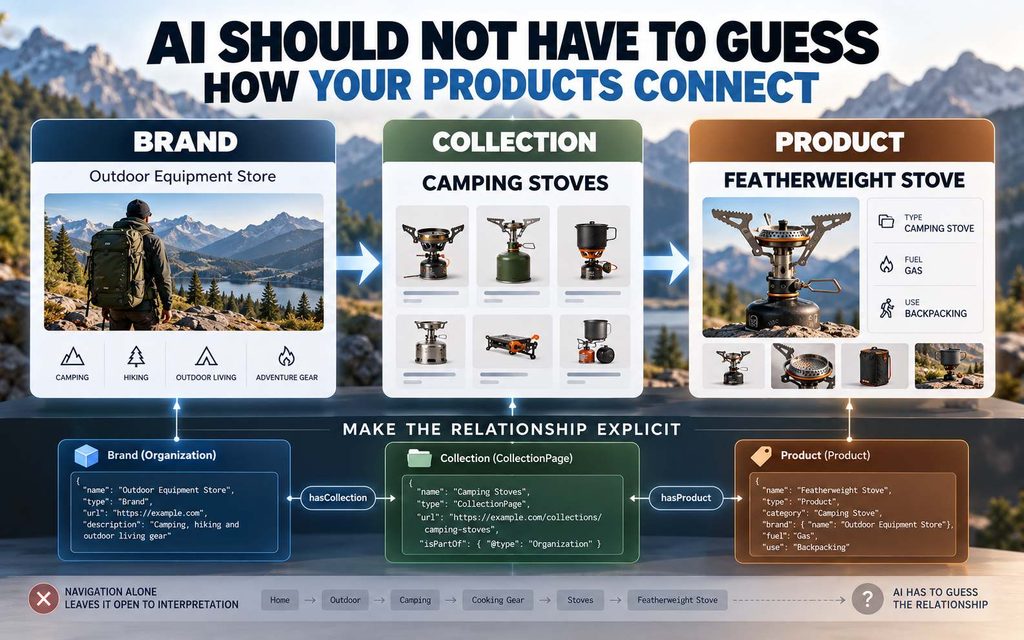
Product → Attribute → Value Relationships
Product attributes turn generic product information into something AI tools can compare directly. A tent’s attribute might be “capacity,” with a value of “4-person.” As Schema.org documents, the additionalProperty field exists specifically for property-value pairs like this, when there’s no dedicated schema.org field already.
Product → Problem → Use Case Relationships
Connecting products to the problems they solve helps AI tools recommend them for the right situation. A waterproof jacket connects to “hiking in wet weather,” for example. This context makes your product more likely to appear in a relevant AI-generated answer. Framing your catalogue around product solutions, not just specs, is what makes this connection visible to AI tools.
How Do You Combine SEO and GEO for Ecommerce?
Here’s the practical checklist version of the sequence above: how to optimize for AI search engines in six concrete steps, not just concepts.
- Start with technical SEO foundations.
- Strengthen brand and entity clarity.
- Improve product information and attributes.
- Create answerable content around customer questions.
- Implement relevant structured data.
- Strengthen brand authority beyond your website.
Start With Technical SEO Foundations
Technical SEO foundations include crawlability, indexability, site architecture, and internal linking. Confirm that search-facing crawlers such as OAI-SearchBot, PerplexityBot, and Claude-SearchBot can access your site in robots.txt. According to OpenAI’s own crawler documentation, OAI-SearchBot is the crawler that surfaces sites in ChatGPT’s search answers, so blocking it removes your store from that pathway entirely.
Strengthen Brand and Entity Clarity
Make your brand, products, categories, and their relationships explicit and consistent across your site. Use Product schema, Brand schema, additionalProperty for attributes without a dedicated schema.org field, and hasVariant where a product comes in different sizes or colours. Consistency here helps AI tools understand your store correctly.
Improve Product Information and Attributes
Complete, factual product information and product attributes help both SEO and GEO. Include specifications, features, benefits, and use cases on every product page.
Make Product Specifications Explicit
List the actual product attributes and value pairs a buyer would compare, like size, material, or capacity. Avoid vague marketing language in place of real specs. AI tools pull these exact details into comparison answers.
Connect Features With Benefits and Use Cases
Explain why each feature matters and which need it solves. A feature without context is harder for both shoppers and AI tools to use. Connect every spec to a real benefit or use case.
Create Answerable Content Around Customer Questions
Answerable content starts with real customer questions, not invented ones. Pull these from Search Console queries, support tickets, or People Also Ask boxes, rather than inventing generic examples. Mark this content up with FAQPage schema so it’s eligible for AI Overview and answer-engine extraction.
Implement Relevant Structured Data
Structured data supports SEO and GEO by making explicit information machine-readable. Name the specific schema types you use, such as Product, Offer, FAQPage, and BreadcrumbList. That’s the core of schema markup for AI search, but it can’t compensate for thin or inaccurate product copy: schema describes what’s already there, it doesn’t fix what’s missing.
Strengthen Brand Authority Beyond Your Website
AI tools corroborate your brand claims against independent sources. Build brand authority through reviews, press coverage, external mentions, and a Wikipedia or Wikidata presence where relevant. Backlinks from credible sites still help both SEO and GEO.
Does GEO Help Ecommerce Brands Appear in ChatGPT Search?
GEO principles are the starting point for how to rank in ChatGPT Search, but no agency can guarantee placement. Some call this ChatGPT SEO, though the mechanics differ from ranking in Google. That’s already covered under the same SEO retainer at iWeb Power, so it’s not a separate line you’d need to negotiate for.
Is ChatGPT SEO the Same as Traditional SEO?
ChatGPT SEO overlaps with traditional SEO, since both rely on clear, well-structured content. The discovery and response experience is different though, since ChatGPT Search generates a direct answer instead of a ranked list. This means the same content needs to work in two different formats.
Can GEO Help Ecommerce Products Get Recommended by AI?
GEO can improve the eligibility of your products for AI recommendations, but it can’t guarantee inclusion. To get ecommerce products recommended by AI, your product data and brand authority both need to hold up.
Product Understanding Comes Before Product Recommendation
AI tools need enough contextual information about a product before they can judge whether it fits a shopper’s need. Without clear product data, an AI tool has nothing to recommend from. This is why product information work comes before recommendation-focused GEO.
Brand and Product Authority Support Discovery
Product information alone isn’t enough. Brand authority signals like reviews, press coverage, third-party mentions, and a credible backlink profile are what turn eligibility into actual AI recommendations.
Is Schema More Important for GEO Than SEO?
Schema isn’t more important for GEO than SEO. It supports both by making explicit information machine-readable, but neither discipline should rely on schema alone.
What Structured Data Can Clarify
Structured data can clarify your products, offers, organisation details, and page relationships like breadcrumbs. Common types include Product schema, Offer schema, FAQPage schema, BreadcrumbList, and Organization schema, added as JSON-LD.
Why Structured Data Does Not Guarantee AI Visibility
Structured data supports understanding, but it doesn’t guarantee citations, recommendations, or inclusion in an AI answer. Content quality, brand authority, and product accuracy still matter more.
How Do You Measure SEO vs GEO Performance?
SEO metrics and GEO metrics need different ways of measuring success. Learning to measure AI search visibility, traffic and revenue starts with separating the two, since each tracks different signals.
SEO Metrics: Rankings, Organic Traffic and Conversions
SEO metrics include keyword rankings, organic traffic, and organic conversions. The goal is business outcomes, not rankings alone. We report on our own Shopify-attributed organic revenue, not just keyword positions.
GEO Metrics: Mentions, Citations and AI Visibility
GEO metrics cover how often your brand or products get mentioned, cited, or recommended by AI tools. This is harder to track than a keyword ranking, but it’s just as real.
Measure AI Referral Traffic and Revenue
Where possible, connect AI discovery to identifiable referral traffic and revenue. This is where GEO ROI becomes measurable instead of theoretical. Use GA4 referral-source segmentation, UTM parameters, and Shopify’s attributed sales reporting. We match Shopify’s backend order data against referral source and UTM tags, not GA4 session counts, so a sale gets credited to organic or AI-referred traffic only when the order itself carries that trail. That’s the difference between a real attributed number and a session that happened to land on your site. We report on our own Shopify-attributed organic and AI-referred revenue this way, so you can see what’s actually working.
Should Ecommerce Brands Prioritize SEO or GEO?
Most established ecommerce brands shouldn’t treat this as an either/or choice. Your priority depends on your current SEO foundations, your growth opportunities, and how your customers actually search.
Prioritize SEO Foundations First
If your technical SEO, site architecture, and authority aren’t solid yet, start there. SEO foundations support everything else, including GEO: a crawler that can’t index your product pages has nothing to hand a generative model in the first place, so GEO work on top of weak SEO tends to stall.
Add GEO to Expand Generative Search Visibility
Once your SEO foundations are solid, GEO extends your generative search visibility further. This is the right time to focus on entity clarity and AI-specific optimisation, since the payoff from clearer brand and product entities compounds faster once crawlers can already reach and index everything cleanly.
Use AEO When Customer Questions Drive Discovery
If your customers often ask specific questions before buying, AEO deserves priority too. Source these questions from Search Console, support tickets, or People Also Ask boxes, so your content matches real intent rather than the generic phrasing an invented FAQ would use, which is what answer engines are most likely to reward with a citation.
What Does an Ecommerce SEO, AEO and GEO Strategy Look Like?
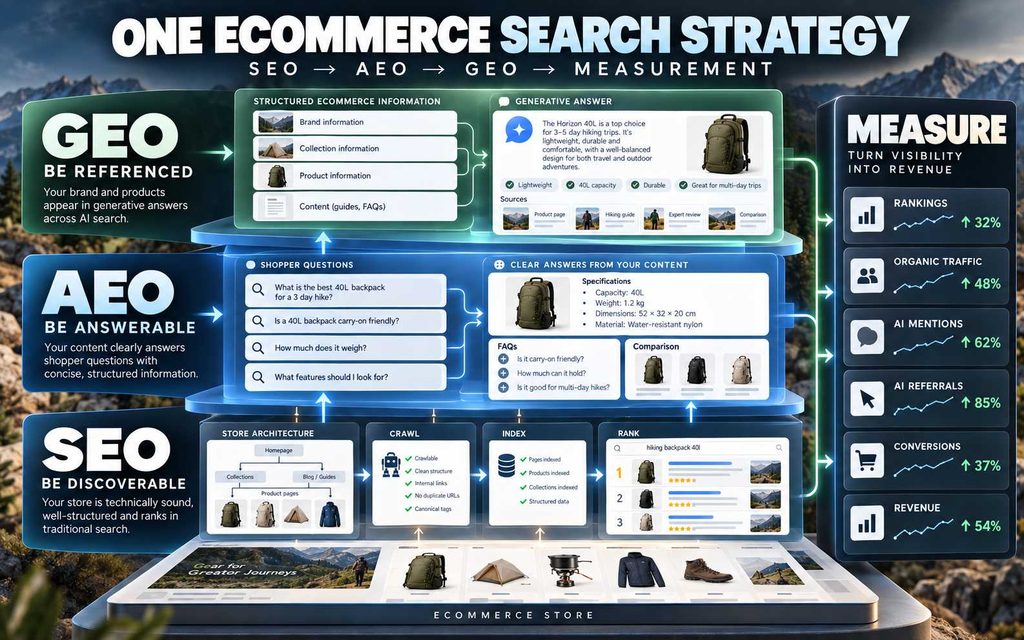
Pulling everything above into one picture: a complete AI search optimization strategy for ecommerce layers search visibility, answerability, generative discovery, and measurement together, not as three separate projects. Here’s what each layer does.
Build Search Visibility With SEO
SEO builds the discoverability layer, so search engines can find, index, and rank your store. This matters because crawlers can only recommend content they can technically access and parse, so weak technical SEO caps how far AEO and GEO can reach, no matter how good your content is.
Build Answerability With AEO
Answer engine optimization (AEO) makes your content easy to understand and directly answers the questions your customers ask. This matters because answer engines extract short, self-contained passages rather than piecing meaning together from surrounding context, so a page that ranks well can still get skipped if its answer isn’t stated plainly near the top.
Build Generative Visibility With GEO
Generative engine optimization (GEO) expands your brand and product discoverability into generative search environments like ChatGPT Search and Google AI Overviews. This matters because generative tools synthesise one answer from multiple sources, so being indexed isn’t enough on its own. Your brand and product entities need to be clear enough for the model to cite them with confidence over a competitor’s.
Frequently Asked Questions
Quick answers to the frequently asked questions about how GEO fits into an SEO retainer. This FAQ covers pricing and scope specifically, not the technical mechanics covered above.
Is GEO Sold as a Separate Service, or Included in an SEO Retainer?
We don’t sell GEO as a separate service. It’s included in every SEO retainer by default, not as a separate line item or an upsell.
Is GEO an Extra Line Item, or Does It Come Bundled With SEO?
GEO doesn’t turn into a separate cost later, either. As the GEO work expands, more schema, more answerable content, more entity clean-up, it stays bundled with your SEO retainer instead of getting quoted as a new line item. That’s different from agencies that price SEO low, then bill AI-search work separately once they’ve got the account.
Ready to Expand Your Ecommerce Visibility Beyond Traditional Search?
We build SEO, AEO, and GEO into one AI search optimization strategy, with Shopify-attributed organic and AI-referred revenue reporting so you can see what’s working. Check AEO and GEO services for ecommerce, or book a free 30-minute strategy call to see where your store stands today.
