
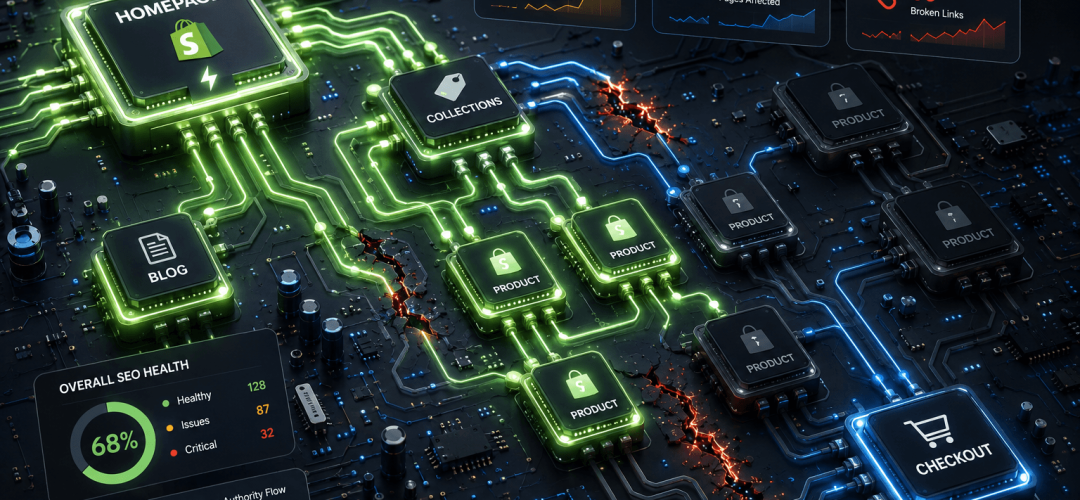
Most Shopify stores scaling past $1M hit a structure wall somewhere between 200 and 500 SKUs. Traffic climbs. Ad spend holds. Organic revenue stalls.
The problem isn’t the product or the channel. It’s that the store’s internal link structure hasn’t kept pace with the catalog. Every new page added without a structured Shopify Internal Linking Strategy is a page that leaks ecommerce SEO revenue instead of capturing it. And as AI search tools like Perplexity and ChatGPT start influencing buyer discovery, the stores with clear content-to-collection link paths are the ones that stay visible.
A Shopify internal linking strategy is the system that controls which pages Google crawls, how authority flows between pages, and how organic visitors move from content to collections to checkout. On a Shopify store with 200+ SKUs, every internal link is a decision about which pages rank, which pages convert, and which pages Google ignores.
The False Assumption: More Content and Pages = More Revenue
Most store owners assume that more pages mean more rankings, and more rankings mean more revenue. It seems logical. Add more collections. Publish more blogs. Expand the product range.
But catalog growth without structure creates complexity. Google has to work harder to understand your site. Important pages get buried. Weaker pages dilute authority. The result is a store that looks bigger but performs worse.
Scaling content without fixing your linking structure is one of the most common ecommerce SEO scaling issues Shopify store owners face. And the ones who fix it see the biggest lift in Shopify SEO growth.
The Real Cost of Weak Shopify Internal Linking: Traffic That Never Turns Into Revenue
Weak internal linking doesn’t just hurt rankings. It costs revenue in three specific ways:
- Wasted traffic: visitors land on informational pages with no path to a product or collection
- Poor conversions: high-intent pages don’t receive enough authority to rank or convert
- Rising CAC: you spend more on ads to replace organic revenue that should already be there
These are ecommerce conversion issues that compound over time. Every month you scale without fixing your Shopify internal linking, the SEO revenue loss gets harder to recover. Understanding your Shopify SEO ROI starts with understanding how much weak linking is already costing you.
Where Revenue Actually Breaks in Shopify SEO
The ecommerce SEO funnel breaks in predictable places. Here’s where to look:
- Non-ranking product or collection pages: exist but receive no organic traffic
- Disconnected blog traffic: attracts visitors but never moves them toward a purchase
- Weak authority flow: PageRank concentrating on low-value pages instead of commercial ones
- Orphan pages: products or collections with no internal links pointing to them at all
- Poor conversion pathways: no logical path from blog to collection to product
These Shopify SEO issues don’t show up as a single error. They show up as flat revenue despite growing traffic. Fixing product page SEO is often where the biggest ranking gains are hiding.
The Hidden Shopify SEO Failure: Internal Linking Doesn’t Scale With Your Store
Here’s what most store owners miss: internal linking doesn’t scale automatically.
When you add a new product, who links to it? When you publish a blog post, does it connect to the right collection? When you create a new collection, is it reachable from your navigation and from related content?
At 50 SKUs, you can manage this manually. At 500 SKUs, the ecommerce architecture changes and the link structure can’t keep up. Shopify internal linking problems emerge from structure breakdown, not laziness. No one owns it, so no one fixes it. And most SEO agencies won’t flag it: fixing structure is harder than writing more content.
The 3-Layer Internal Linking System for Revenue Growth
A structured internal linking strategy uses three layers, each with a specific job. This ecommerce SEO framework maps how Shopify stores should move authority, traffic, and intent from one page type to the next. Fix all three and organic revenue compounds. Leave one broken and the other two underperform.
Indexation Layer: What Gets Crawled and Ranked
This layer controls crawlability: reduce orphan pages, clear crawl bloat, ensure important pages are discoverable. Crawl budget is the number of pages Googlebot will crawl on your site in a given period. As Google Search Central’s crawl budget guidance explains, if Google spends too much time on URLs that aren’t worth indexing, it may not allocate enough resources to the rest of your site. Shopify technical seo and crawl optimization start here. If Google can’t crawl it, it won’t rank.
On Shopify specifically, the common culprits are faceted navigation URLs (filtering by color, size, or material creates thousands of crawlable pages that dilute crawl budget), duplicate collection URLs from tag combinations, and orphaned products sitting five or six clicks from the homepage.
Orphan pages and crawl bloat are what indexing problems actually look like in practice, this layer and that post are describing the same underlying failure from two angles.
Key fixes in this layer:
- Fix orphaned products and collections
- Reduce crawl depth on high-value pages
- Control index bloat from faceted navigation or duplicate URLs
Authority Distribution Layer: What Actually Ranks
PageRank is Google’s measure of a page’s relative authority based on how many links point to it and from where. Internal links pass that authority from page to page inside your store. This layer controls that flow: it strengthens commercial pages (collections and products) by routing authority from high-traffic blog and category content. Google’s own link best practices documentation is clear: every page you care about should have a link from at least one other page on your site.
Strong internal linking authority flow is what separates stores that rank from stores that don’t. The difference comes down to seo structure: who controls where PageRank flows through the store. On Shopify, PageRank typically pools on the homepage and blog index. The commercial collection pages that should be converting organic visitors get almost none of it.
Key fixes in this layer:
- Link from high-traffic blogs to relevant collections
- Prioritise collection pages in navigation hierarchies
- Remove links to low-value or thin pages
Conversion Path Layer: What Drives Revenue
This layer connects traffic to revenue. It maps the route from blog post to collection page to product page so organic visitors have a natural path toward a purchase.
On Shopify, most stores break this layer in the same place: blog traffic that never reaches a collection. A post ranking for a high-intent keyword sends visitors to read, then exit. There is no link to the matching collection page. The session generates no revenue. Ecommerce conversion paths built into your link structure mean SEO drives sales, not just clicks. Done well, SEO to revenue comes through conversion rate optimization, not through adding more content.
Key fixes in this layer:
- Map every high-traffic blog post to its closest matching collection page
- Ensure collection pages surface your highest-converting products, not just the newest ones
- Add cross-sell and related product links that keep organic visitors inside the purchase funnel
How to Build a Scalable Internal Linking System
Translating this framework into your Shopify SEO strategy requires four things. A scalable SEO structure doesn’t happen by accident. Here’s the site structure shopify stores need at scale:
- Content hubs: blog clusters that funnel traffic to commercial pages
- Site architecture: collections, hierarchies, and menus designed for crawl efficiency
- Contextual links: in-content links that reinforce topical relevance
- Governance: a process so new pages get linked correctly from day one
Site Architecture That Doesn’t Collapse at Scale
A scalable Shopify site structure is the foundation of solid ecommerce architecture. Important pages should be reachable within two to three clicks from the homepage. Deep navigation buries pages. Buried pages don’t rank.
Product-Level Linking That Drives Rankings and Sales
Every product page should receive links from at least one collection page and one related blog post. Variants, related products, and cross-sell sections all pass authority and keep users on the site longer. Product internal linking is one of the fastest ways to lift rankings on ecommerce product SEO pages.
Turning Content Into a Revenue Engine, Not Just Traffic
Blog content should never be a dead end. Every post should link to at least one collection page using relevant anchor text. Blog to product linking is what turns informational traffic into commercial sessions. That’s the foundation of ecommerce content seo: blog seo isn’t separate from your sales funnel. It IS the top of it.
High-Leverage Linking Opportunities Most Stores Miss
These are the internal linking opportunities most Shopify stores overlook:
- High-traffic blog posts with no link to a collection page
- Orphaned products with zero internal links
- Underlinked collections with strong commercial intent
- Category pages with unused authority sitting in navigation menus
- Pages surfaced in seo audit insights that rank but don’t convert
Why DIY Internal Linking Breaks at Scale
The real ecommerce seo challenges aren’t technical. They’re organisational. No one owns internal linking issues across content, dev, and merch teams. SEO, content, and product operate in silos. Processes aren’t in place when new pages go live. Audits don’t run regularly enough to catch the drift.
If you’ve worked with SEO agencies before, you’ll recognise this gap: internal linking rarely makes it into the deliverables. Rankings reports, keyword tracking, content calendars: those are easier to produce and charge for. Fixing link architecture requires understanding your entire page hierarchy and maintaining it as the store grows. Most agencies skip it entirely.
DIY Shopify SEO and internal linking tools can identify issues. They can’t fix the underlying structure or build the governance process. A crawl report tells you what’s broken. It doesn’t tell you what to prioritise, how to fix it at scale, or how to prevent it recurring. As Google’s ecommerce site structure guide explains, Google infers page importance from the number of links it takes to reach each page. Link structure decisions have direct ranking consequences, not just crawl consequences.
If you’re managing 200+ pages, the complexity of internal linking decisions outgrows what a single person can handle without a system. Working with an SEO expert who owns the full structure, and who tracks fixes against revenue not just rankings, is often the fastest way out of the loop.
What Fixing Shopify Internal Linking Actually Looks Like
A proper fix has four stages:
- Crawl audit: identify orphan pages, crawl depth issues, and wasted authority
- Page mapping: prioritise which pages need links and from where
- Authority mapping: model how PageRank should flow through your store
- Link architecture: implement the structure, then set up governance so it holds
This is Shopify SEO implementation. Not a one-time fix. It’s a system you build once and maintain as you scale. Good ecommerce seo services include this as a core deliverable. Stores that fix structure before scaling ad spend recover faster and compound organic revenue at a higher rate. In Shopify analytics, the pattern is consistent: collection pages that were invisible in organic reports start attributing sessions and sales within two to three months after structure fixes go in. That’s what we track across client stores in Shopify’s attribution dashboard.
Internal Linking and AI Search: The Structure AI Engines Depend On
Every other post in this series eventually points back to internal linking as part of what makes a page legible to AI search. This is where that claim actually gets made in full.
ChatGPT Search, Perplexity, and Google’s AI Overviews don’t browse your store the way a shopper does. They extract from pages that clearly signal what they are and how they relate to everything else on the site, and internal links are the primary way that relationship gets signalled. A product page with no links from a collection or supporting content isn’t just hard for Google to rank, it’s a page with no context an AI engine can use to understand where it sits in your catalogue or why it matters.
The same three layers that fix revenue also fix AI visibility, because they’re solving the same underlying problem. The indexation layer determines whether an AI crawler can find the page at all. The authority distribution layer signals which pages are actually important, the same signal AI tools weight when deciding what’s worth citing over a competitor’s page. The conversion path layer, blog to collection to product, is also the clearest path an AI engine can follow to understand your catalogue’s structure and recommend a specific product rather than a generic answer.
Stores treating internal linking as a ranking tactic are underusing it. It’s increasingly the infrastructure that determines whether you exist in either search layer at all.
Fix Internal Link Gaps Before Scaling More SEO Traffic
Scaling SEO traffic into a broken structure compounds losses. Every new blog post that doesn’t connect to a collection is wasted. Every new product page with no links is an orphan. Fix the foundation first, then scale.
SEO scaling without structure isn’t an ecommerce growth strategy. It’s a bet that the mess won’t matter. The stores that grow organically year on year aren’t the ones with the most content. They’re the ones with the best structure.
When Weak Internal Linking Becomes a Shopify Growth Bottleneck
These are the signals your internal linking is holding back growth:
- Organic revenue is flat despite growing traffic
- Ranking issues on commercial pages (collections, products)
- Inefficient traffic scaling: more visitors, same conversions
- Orphan pages appearing in crawl reports
- Weak product discovery from search
- Heavy reliance on paid channels because organic can’t be trusted to deliver
When two or more of these appear together, you’re looking at ecommerce growth bottlenecks driven by structure, not by content. These seo performance issues compound: every month you scale into broken structure adds cost and complexity. A shopify seo audit will confirm whether internal linking is the bottleneck and exactly where the structure is breaking down.
Shopify Internal Linking FAQ
How many internal links should a Shopify product page have?
There’s no fixed number, but every product page should be reachable from at least one collection page and one related blog post at minimum. Add variant links, related products, and cross-sell sections on top of that baseline, each one passes authority and gives visitors another reason to stay on the site.
What’s an orphan page and why does it matter?
An orphan page is a product or collection with no internal links pointing to it at all. Google finds pages primarily by following links, so an orphan page is difficult to crawl, rarely indexed reliably, and functionally invisible even though it’s live on your store.
Should every blog post link to a collection page?
Yes. A blog post with no link to a matching collection generates a session that reads and leaves, it never gets the chance to convert. Every post should link to at least one relevant collection using anchor text that matches the page’s topic.
How is internal linking different from site navigation?
Navigation is what users click through deliberately, internal links are contextual connections inside content and templates. Both matter, but internal links are the signal Google and AI engines weight most heavily when deciding which pages matter, because they represent an editorial choice rather than a structural default.
Can internal linking tools fix this automatically?
They can identify problems, orphan pages, missing links, weak anchor text, but they can’t fix the underlying structure or decide which pages deserve priority. That takes a page-by-page map of your catalogue and a governance process so new pages get linked correctly from day one, not just a crawl report.
Does internal linking really affect AI search visibility?
Yes, directly. AI engines extract from pages that clearly signal what they are and how they relate to the rest of the site, and internal links are the primary way that signal gets sent. A page with no links in or out gives an AI crawler nothing to work with, regardless of how good the content on the page itself is.
Get a Shopify Internal Linking Audit: Find Where You’re Losing Revenue
If your Shopify store is growing but organic revenue isn’t keeping pace, the structure is likely where the gap is. iWeb Power provides shopify internal linking services as part of a full seo audit shopify owners actually use: crawl analysis, authority mapping, link architecture, and a prioritised fix list with findings tied to your Shopify revenue data, not generic ranking metrics.
One client’s audit found their product content wasn’t rendering for AI crawlers at all; fixing that, alongside cleaning up crawl errors after a theme migration, helped them generate $84,123.17 in SEO-attributed revenue in a single month, including $4,180.80 from ChatGPT referrals. Clean internal-link architecture is part of what makes AI crawlers able to find and understand that content in the first place.
Get expert Shopify SEO help and find out exactly where your store is losing revenue.
