
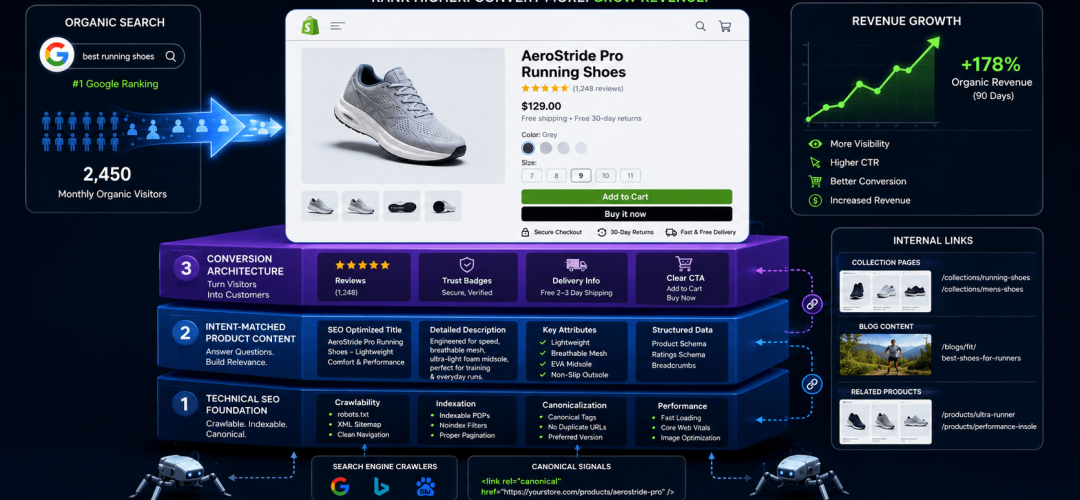
Ranking and revenue are two different problems. One of our clients was doing $1M+ in annual Shopify revenue with solid page-one rankings across their top product categories. Organic conversion rate: 0.4%. Paid: 2.1%. Same products, same prices, same traffic intent. The gap was entirely in the pages.
Here’s the short version. Shopify product page SEO improves your Google rankings and turns high-intent visitors into buyers. The approach that works combines three things: technical fixes (crawlability, duplication), intent-matched content (titles, descriptions, schema, images), and conversion architecture (trust signals, UX). Done right, it lowers your customer acquisition cost and compounds organic revenue over time.
We measure product page SEO the way you do: by revenue attributed in your Shopify backend, not rankings in a report. Not sessions. Not positions. Sales.
If you’re running $1M+ a year and active ad spend, you already know the difference between organic traffic that shows up in your attribution data and organic traffic that shows up in Google Analytics and disappears at the checkout. This guide is for the second problem.
Most Shopify store owners watching their ad costs climb have already felt it. Organic traffic comes in, but sales don’t follow. You’ve seen the session counts. You’ve seen the rankings. The conversion data tells a different story.
When product pages underperform, the problems show up fast:
- Rising customer acquisition costs despite stable traffic
- Organic sessions that don’t convert
- Scaling ad spend to compensate for organic underperformance
- Missed demand from buyers already searching for what you sell
This guide covers why it happens, how to fix it, and what to prioritise first.
Why Shopify Product Page SEO Breaks as You Scale
Small stores can get away with basic product pages. Scaling stores can’t.
As your SKU count grows, so do the Shopify product page SEO problems:
Duplicate content from variant URLs, filtered pages, and Shopify’s default URL structure. Google’s own crawl budget guidance confirms that duplicate content makes Google spend crawl time on repeated URLs, leaving less budget to reach your most important product pages.
- Weak templates that push the same thin copy across hundreds of products
- App conflicts that slow load times or inject unindexed content
- Inconsistent structure across product types and collections
These aren’t one-off issues. They compound. They get harder to fix the longer you wait.
The Hidden Revenue Leak: Ranking Without Converting
Ranking isn’t enough. A product page that sits on page one but fails to convert wastes your organic traffic budget and inflates your effective CAC.
Industry benchmarks put average ecommerce conversion rates around 1–2% across sectors. For a store doing $1M+ a year, closing even half the gap between 0.4% organic and a 1.5% average on just your top 20 PDPs is worth more than any ranking report you’ve ever received.
The fix isn’t more traffic. It’s closing the gap between ranking and revenue.
Here’s what ranking-without-converting looks like in practice:
- Sessions from organic search are high
- Add-to-cart rate is low
- Revenue per organic session sits well below your paid benchmarks
- You’re scaling spend to hit targets your organic channel should already be hitting
There’s a fast way to tell whether you have a page problem or a traffic problem. Compare revenue per session from organic against revenue per session from paid for the same products. If organic sits well below paid, the bottleneck isn’t your rankings. It’s what happens after the click. A traffic-side team responds by adding more content. A page-side team fixes the PDP. Most stores spend a year on the first when the second was the real constraint all along.
The 3-Layer System for High-Performing Product Pages
This is the core product page SEO strategy that turns underperforming PDPs into revenue assets. It runs on three layers working together, with internal linking tying them to the rest of your store.
Fixing Crawlability, Duplication, and Site Architecture
Before content and conversion, your Shopify technical SEO foundation needs to be solid. Google has to find and index your pages cleanly before anything else matters.
Common issues that hurt product page visibility:
- Index bloat from faceted navigation creating thousands of low-value URLs
- Canonical errors that split authority between duplicate variant pages
- Crawl inefficiencies that stop Google from reaching your most important PDPs
- Duplicate URL paths from Shopify’s /collections/ and /products/ structure
Fixing these through proper canonicals, robots directives, and URL structure is the foundation of solid technical SEO. It clears the path for rankings to improve.
One easy fix inside that same URL structure work: the product handle itself. Shopify auto-generates it from the product title, which often produces something like /products/the-blue-oxford-dress-shirt-for-men-size-large-new-2026. Trim it to the keyword that actually matters, /products/blue-oxford-dress-shirt-mens, and you get a cleaner, more clickable URL without touching canonicals or redirects.
Optimising Product Titles, Descriptions, and Search Intent
Once your pages are crawlable, the content needs to match what buyers search for.
That means:
- Product title SEO that targets commercial keywords, not just catalogue names
- Descriptions written for buyer intent, not brand copy
- Product attributes (size, material, compatibility) structured for search visibility
- On-page SEO elements (H1, meta title, meta description) aligned to the same keyword theme
Most Shopify stores skip this step. Their product titles match the supplier catalogue, not the search bar. Shopify’s default template appends your store name to every title, and on a longer store name that alone can eat 20–30 characters of Google’s roughly 60-character display limit. “Men’s Waterproof Hiking Boot — [Store Name]” can run past 60 characters and get cut off mid-word. “Men’s Waterproof Hiking Boot | Gore-Tex, Wide Fit” fits cleanly, leads with the keyword, and adds a real differentiator instead. That’s a ranking gap you can close quickly with the right on-page SEO approach.
Product Schema and Images: The Data Google and AI Actually Read
A page can have great copy and still be invisible to rich results if the underlying data is missing. Google’s Product rich results, price, availability, and star ratings shown directly in search, require valid structured data. Most Shopify themes generate partial schema out of the box: enough to pass basic validation, not enough to actually unlock rich results.
The fields that matter most:
- Price and currency, formatted as a number, not a string.
- Availability, matching what’s actually visible on the page. A page that says “in stock” with schema that still says “out of stock” is a trust signal search engines and AI tools both penalise.
- Aggregate rating, pulled dynamically from your review app rather than hard-coded. A static rating that doesn’t match your real review count is against Google’s structured data policies.
Images matter for the same reason, just on the visual side. Descriptive alt text (“Oxford blue slim-fit cotton dress shirt, front view” instead of “image-1” or a keyword-stuffed sentence) gives both image search and AI tools something concrete to work from, and a compressed hero image is usually the single biggest lever on a product page’s load speed, since it’s typically the element Google times for LCP.
Turning SEO Traffic Into Revenue, Not Just Clicks
Traffic that doesn’t convert doesn’t count. Ecommerce conversion optimisation is where rankings become revenue.
The CRO elements that move organic visitors toward buying:
- Clear pricing, availability, and delivery information above the fold
- Social proof (reviews, trust badges, star ratings) placed near the purchase decision
- Minimal friction in the path from landing to checkout
- Offer clarity: what the buyer gets, why it’s worth it, why now
These aren’t design opinions. They’re conversion architecture. A Google-commissioned Deloitte study (“Milliseconds Make Millions”) found that a 0.1-second improvement in mobile load speed increased retail conversions by 8.4% and lifted average order value by 9.2%. Page performance is a direct revenue lever on product pages, and it’s worth pairing this work with a dedicated speed pass rather than treating it as a one-off fix.
Since most of that traffic is arriving on a phone, a few mobile-specific signals are worth checking directly on your top PDPs:
- Add-to-cart button visible without scrolling
- Tap targets sized so variant selectors and buttons aren’t easy to mis-tap
- No pop-up or interstitial blocking the page on load
The goal is to convert organic traffic into actual sales, not just sessions.
Internal Linking That Actually Drives Rankings and Sales
Internal linking is how Google understands your store’s structure. It’s also how shoppers discover more of what you sell.
A strong Shopify internal linking strategy for product pages:
- Connects product pages to relevant collection pages, passing authority up
- Links from high-traffic blog or category content down to PDPs
- Surfaces related products in ways that lift average order value
- Gives Google a clear crawl path to your most important commercial pages
Done well, internal linking is one of the fastest ways to lift rankings on pages you already own.
What Shopify Product Page SEO Fixes to Prioritise First If You Only Have 30–60 Days
With limited time, focus on the fixes with the highest revenue impact first. A clear Shopify SEO prioritisation framework helps you avoid spending weeks on changes that won’t move the needle.
The product page SEO strategy for a 30–60 day window comes down to sequencing correctly.
Product Page SEO Fixes: Fast PDP Wins vs Template-Level Changes
These SEO quick wins for ecommerce can start moving metrics within weeks. Structural changes take longer but create compounding returns.
| Fix type | Example | Timeline |
| Fast PDP wins | Title tag updates, meta descriptions, adding reviews | 1–2 weeks |
| Template-level changes | Canonical structure, schema markup, structured content blocks | 3–6 weeks |
| Architecture fixes | Faceted navigation, URL structure, crawl path | 4–8 weeks |
Start with the fast wins. Ship them while the template work is scoped.
When Product Page SEO Becomes a Shopify Growth Bottleneck
Once a store is doing $1M+ a year, growth bottlenecks rarely look like technical problems. The signs are easy to miss until they get expensive:
- Organic traffic is flat or declining despite publishing new content
- CAC is rising and paid ROAS is under pressure
- SEO traffic converts at a fraction of your paid channel rate
- You’re adding SKUs faster than you’re fixing the pages they live on
When these signals appear together, it’s time for a proper Shopify SEO audit for growth bottlenecks, not more content.
Why Most Teams Never Fully Fix Product Page SEO
Ecommerce SEO challenges aren’t only technical. Most Shopify teams know there’s a problem. Most never fully solve it. Here’s why:
- Dev capacity is locked on roadmap priorities, not SEO
- No single person owns product page performance end-to-end
- Template changes feel risky without proper QA
- The work spans SEO, content, dev, and CRO, and those teams rarely align
- Quick wins get shipped while structural fixes get deprioritised indefinitely
If your internal team can’t close these gaps, it’s worth considering whether to hire a Shopify SEO expert who works across all of them. The difference to look for: can they run metadata optimisation across 200+ PDPs in a single pass, or do they quote you 3 months of manual work? Agencies still billing by the hour usually can’t move that fast. The ones running AI-powered delivery against what’s actually losing you revenue can.
What Full-Stack Shopify PDP Optimisation Actually Covers
Real ecommerce SEO services go well beyond title tag updates. Proper Shopify product page SEO services should cover the full stack:
- Technical audit: crawlability, duplication, canonicals, index health
- PDP prioritisation: identify highest-opportunity pages by traffic, intent, and conversion gap
- Template fixes: structure changes that scale across product types
- Metadata updates: title tags, meta descriptions, H1s aligned to commercial intent
- Content improvements: descriptions, attributes, schema
- CRO testing: conversion elements tested and iterated
- Internal linking: authority flow mapped and implemented
- Iteration: performance tracked, fixes adjusted over 90-day cycles
If it doesn’t cover all eight, the fix will be incomplete.
Product Page SEO and AI Search: The Next Layer Most Stores Are Missing
Google is no longer the only discovery layer. ChatGPT Search, Perplexity, and Google’s AI Overviews are now surfacing product recommendations directly from page content. If your product pages have thin descriptions, no structured attributes, and weak schema, you are invisible in that layer, not just under-ranked in it.
The stores building an organic traffic moat right now are doing two things simultaneously: fixing traditional Google PDPs and pre-structuring their product content for AI search extraction. That means richer product descriptions with specific attributes, FAQ sections tied to product use cases, and Product and FAQ schema that feeds directly into LLM-readable structured data.
What makes a PDP citable rather than just indexed: a clean H1 with the product name, price and availability stated clearly near the top rather than buried in a script, accurate Product schema, and no near-duplicate variant URLs competing for the same query. A store that has that on its top 20 PDPs is positioned for both Google and AI search. A store that doesn’t is competing for neither.
This is not a 2027 problem. It is showing up in attribution data today for product categories with high research intent.
Shopify Product Page SEO FAQ
Does product page SEO matter if my PDPs already rank?
Yes. Ranking and converting are separate problems. A page can hold position one for months and still run revenue per session below your paid benchmark. If organic converts at a fraction of paid, the fix is the page, not the rankings.
What should I fix first if I only have 30–60 days?
Start with fast PDP wins: title tags, meta descriptions, and adding reviews. These can move metrics in one to two weeks. Scope the template and architecture work to run in parallel, since those take three to eight weeks.
Why is my Shopify organic traffic not converting?
Usually the page, not the product. Weak titles miss buyer intent, thin templates repeat across SKUs, and missing trust signals like pricing, reviews, and delivery info stall the purchase decision. Duplicate URLs from variants and filters can also bury your best PDPs before they rank.
Is more content the answer to flat ecommerce SEO?
Rarely. If you’re adding SKUs and content faster than you’re fixing the pages they live on, more content compounds the problem. Fix crawlability, conversion, and internal linking on the pages you already own first.
Get Your Shopify PDPs Fixed at the Revenue Level
Scaling traffic to broken product pages doesn’t grow revenue. It compounds waste. The fix isn’t more content or more ad spend. It’s closing the gap between your organic rankings and what those rankings actually produce in your Shopify backend.
Our Shopify product page SEO services cover the full stack: technical, content, conversion, and AI search readiness. Every result is tracked in your Shopify attribution data, not a rankings dashboard. One Australian homewares and bathroom retailer we work with generated $105,533.79 AUD in Shopify-attributed organic and AI-referred revenue in a single month, on a $2,980 AUD/month retainer, a 35x return. Product pages carried a meaningful share of that. One of our own audits found a client’s product content wasn’t rendering for AI crawlers at all; fixing that, alongside cleaning up crawl errors after a theme migration, helped them generate $84,123.17 in SEO-attributed revenue in a single month, including $4,180.80 from ChatGPT referrals.
Book a 30-minute assessment. We pull your store’s organic-vs-paid conversion delta in the first session and show you exactly where the revenue gap is coming from. No ranking reports.
