
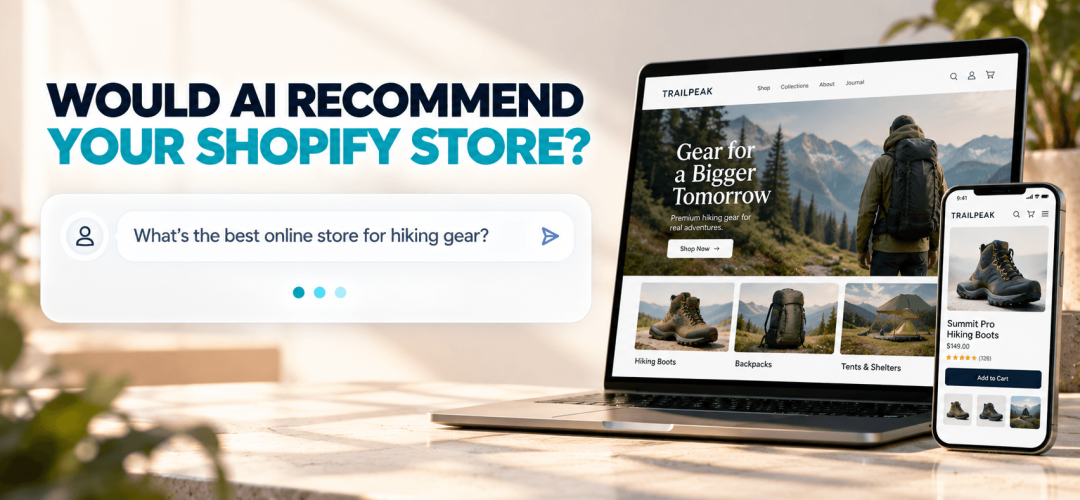
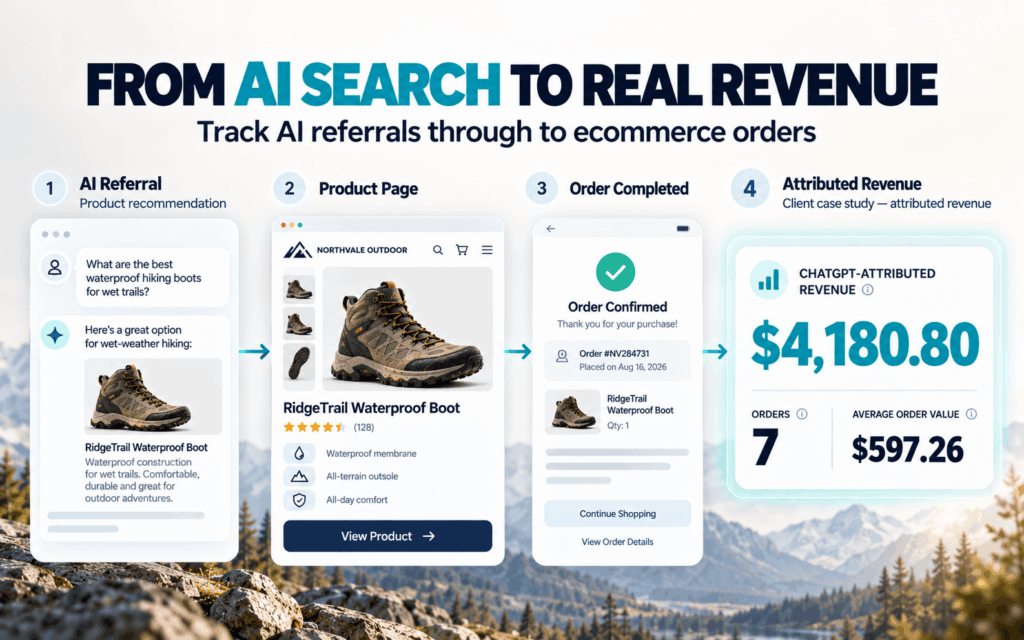
Here’s a concrete example of what that looks like: one of our ecommerce clients pulled $4,180.80 in Shopify-attributed revenue from ChatGPT referrals alone last quarter. 7 orders at a $597.26 average order value, tracked back to the actual sale, not just a ranking (full case study below). That’s what AI search optimization looks like when it’s done right: crawlable pages, clear brand and product entities, real buyer questions answered directly, structured data, and AI referral traffic tracked all the way to revenue, not just mentions. This builds on strong ecommerce SEO. It doesn’t replace it.
Most stores still treat AI search as an afterthought. They fix it once ChatGPT or Perplexity start sending real traffic, by which point competitors are already cited and they aren’t.
That’s the challenge. The brands that wait too long realise AI search optimization isn’t a bolt-on project. It needs the same foundations as good SEO, applied with a sharper focus on entities, answers and structured data. The brands that get ahead want to be the answer AI engines give, not just a link buried in a results page. This guide walks through exactly how to optimize for AI search engines, from technical access through to measuring whether it’s working.
By the end, you’ll know how to make your store readable to AI crawlers, how to structure product and brand information so AI engines understand it, and how to measure whether any of it is paying off. The rest of this guide walks through it in order: stop guessing whether you’re visible, and start proving it with revenue, not rankings.
What Is AI Search Optimization?
AI search optimization, sometimes called AI SEO, means making your store’s content, entities and structure easy for AI systems to find, understand and cite. It covers discoverability, relevance and visibility across AI-assisted search experiences like ChatGPT Search, Perplexity, Google AI Overviews, Gemini, Claude and Microsoft Copilot.
How Is AI Search Different From Traditional Search?
Traditional search returns a ranked list of links for the user to evaluate. Google explains that AI Overviews instead provide an AI-generated snapshot with key information, synthesising multiple sources into one generated answer, recommendation or summary. Google rolled AI Overviews out to default US search results on May 14, 2024, so for most shoppers this isn’t an experiment anymore. It’s what search already looks like.
For example, a shopper asking “best waterproof hiking boots under $200” on Google gets ten blue links. The same question on ChatGPT might get three named products with a short explanation of why each fits, pulled straight from product and review content. For a deeper look at how the two disciplines diverge, see our GEO vs SEO comparison.
What Does AI Search Optimization Try to Improve?
AI search optimization tries to improve your AI visibility: how well AI systems understand your brand and products, how often they cite or recommend you, and how much qualified traffic and revenue that generates. The real measure isn’t mentions. It’s whether those mentions turn into visits and sales.
How Do SEO, AEO and GEO Fit Into AI Search Optimization?
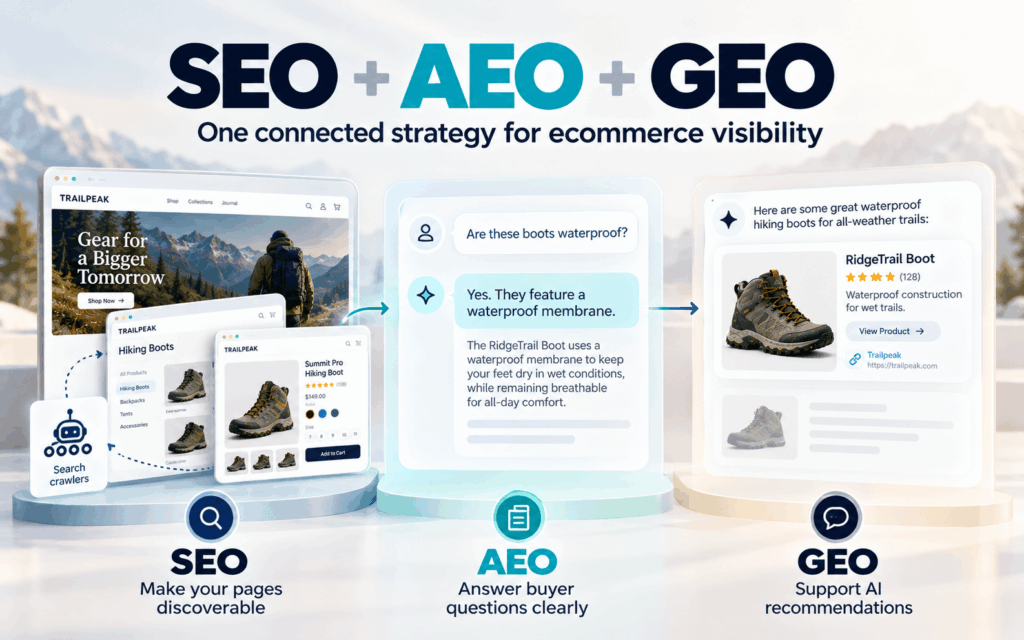
SEO, AEO and GEO aren’t three separate strategies competing for budget. They’re three layers of the same system, each solving a different part of the AI search problem.
SEO Builds the Search Foundation
SEO gives AI systems something to find in the first place. That means the same crawlable pages, clean architecture and earned authority you’d build for any strong ecommerce SEO foundation.
Confirm that AI crawlers like OAI-SearchBot, PerplexityBot, Claude-SearchBot and Googlebot aren’t blocked in your robots.txt. These are the crawlers that actually power live AI search results, different from training-only crawlers like GPTBot, ClaudeBot and Google-Extended, which feed model training rather than real-time citations. OpenAI’s own documentation confirms its crawlers identify themselves by specific user-agent strings, like OAI-SearchBot/1.4, and can be allowed or disallowed independently of each other. Consider an llms.txt file and server-side rendering so these bots see full page content, not a blank shell waiting on JavaScript.
AEO Improves Answerability
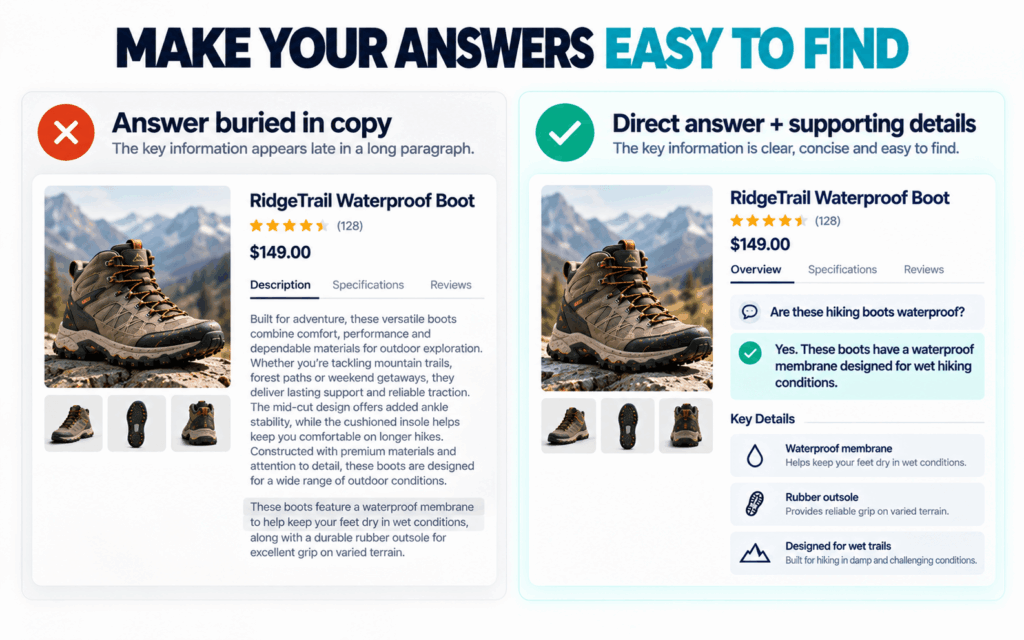
Answer Engine Optimization (AEO) makes your content directly useful for question-driven searches. It’s less about ranking and more about whether your page actually answers the question being asked, clearly and completely. Mechanically, this matters because an AI engine usually extracts one passage to cite, not the whole page, so a buried or unclear answer gets skipped even when the underlying information is correct.
How Is AEO Different From SEO?
The core AEO SEO difference is simple: AEO focuses on answering specific questions clearly, SEO focuses on broader visibility and ranking. They work together. For the full comparison, see our AEO vs SEO breakdown.
GEO Extends Optimization Into Generative Search
Generative Engine Optimization (GEO) extends this further into generative search environments, where the goal is being understood well enough to be cited, summarised or recommended by the AI itself, not just ranked. It works by feeding the model’s retrieval step content it can confidently attribute, so vague or unverifiable claims are more likely to be left out of the generated answer entirely, not just ranked lower.
How Do You Optimize an Ecommerce Website for AI Search?
Here’s the practical framework for how you optimize an ecommerce website for AI search. Each step builds on the one before it, so work through them in order rather than jumping to the parts that feel most interesting. Done well, this is what ecommerce AI search optimization looks like in practice: crawlability, entity clarity, product depth and structured data working together.
1. Make Important Pages Crawlable and Accessible
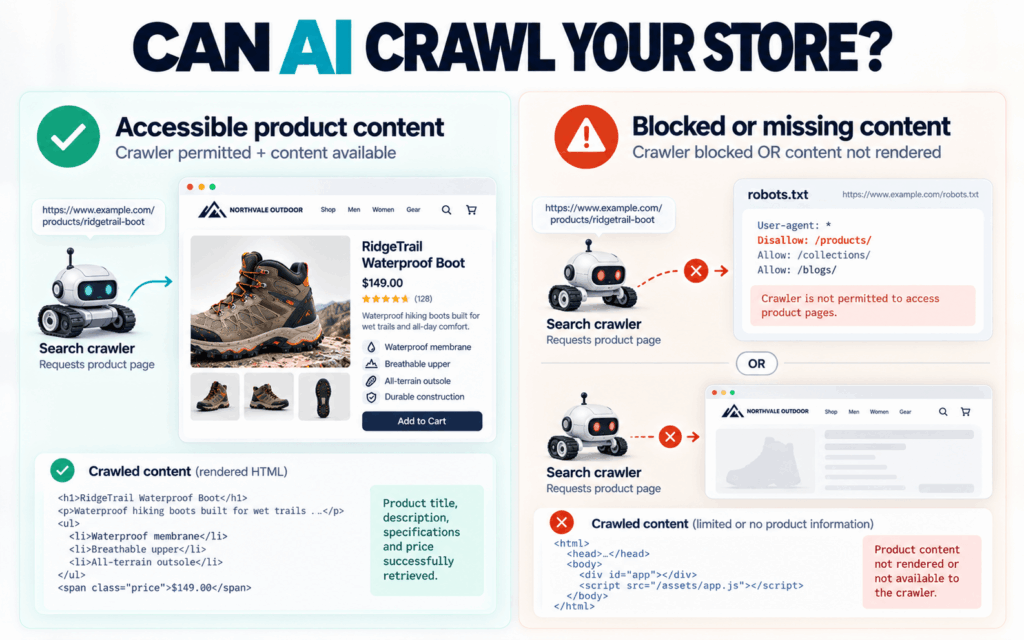
If a page can’t be reached, nothing else on this list matters. AI crawlers can’t understand content they can’t retrieve, no matter how well it’s written.
Check crawlability and indexability. Review your robots.txt, sitemap and any JavaScript rendering issues that could hide content from bots.
Keep important information accessible in page content. Don’t bury key product or brand facts in images, carousels or tabs that require a click to reveal. Crawlers read the raw HTML and text that loads without any interaction. A fact baked into an image with no alt text, or hidden inside a tab that only renders after a click, is often invisible to them even though a shopper can see it fine.
2. Define Your Brand Entity Clearly
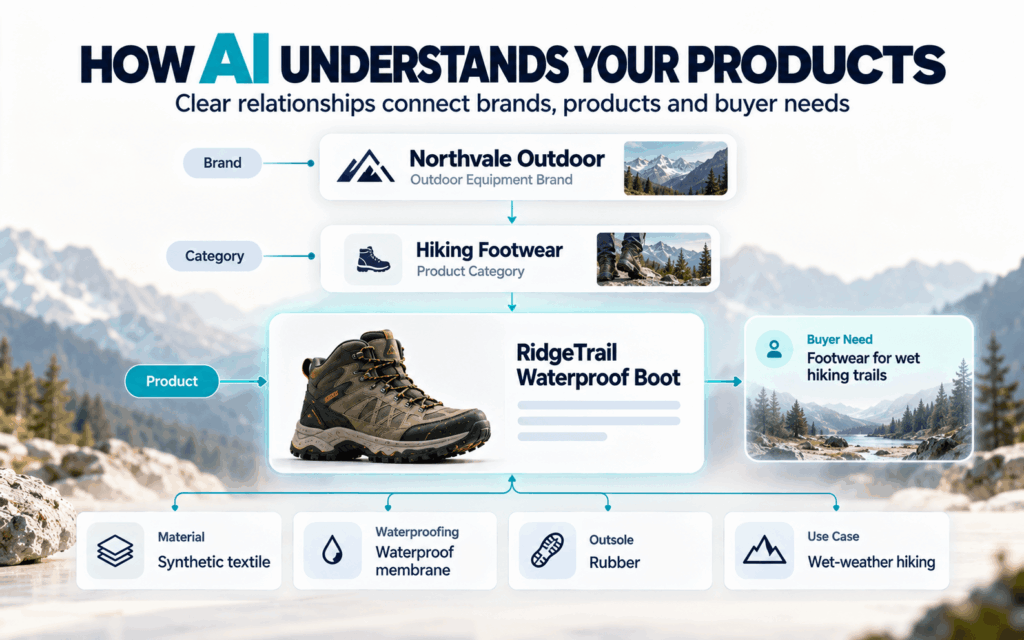
AI engines need an unambiguous answer to “who is this brand, and what do they sell?” That clarity comes from consistent facts and explicit relationships, not marketing copy.
Brand consistency means your name, category and description match across your homepage, About page and schema markup. When they don’t, the AI has to guess which version is authoritative, and an uncertain match is more often left out of a generated answer than cited wrong.
Connect the brand to relevant categories and products. Make the Brand → Category → Product chain explicit, both in copy and in structured data.
3. Make Product Entities Easy to Understand
Treat each product as a defined entity with explicit attributes, not just a paragraph of promotional copy. AI engines parse structured attribute-value pairs, like Schema.org’s hasVariant and additionalProperty, far more reliably than descriptive copy, which is why vague specs get left out of generated comparisons.
Define product → attribute → value relationships. State specifications plainly: material, size, capacity, compatibility.
Define product → problem → solution relationships: name the customer problem, then state the product solutions that address it directly.
Define product → audience → use case relationships. Say who it’s for and when they’d use it.
4. Improve Product Page Information Completeness
Stronger product pages give both shoppers and AI systems more to work with.
Include specifications and important attributes. Use real attribute/value pairs (dimensions, materials, compatibility), not vague marketing adjectives.
Explain features, benefits and use cases. Connect what the product has to why it matters.
Answer purchase-relevant questions. Pull real questions from Search Console, support tickets or People Also Ask boxes rather than inventing generic ones.
5. Optimize Collection and Category Pages
Collection pages should work as semantic hubs that explain a category, not just grids of products.
Start with a clear category definition: what the category contains and where its boundaries sit.
Explain the product selection criteria shoppers actually use to choose between products: size, material, price tier, whatever matters in your category.
Connect collections with relevant products and guides through ecommerce internal linking that stays contextual, not a sitewide footer dump.
6. Create Content Around Real Customer Questions
Question-based content built from genuine customer questions works as supporting detail on one strong page, rather than spinning up a thin new page for every near-identical question.
Identify informational questions customers ask while learning about a category.
Identify comparison questions customers ask when weighing products or alternatives.
Identify purchase questions that directly affect the buying decision.
7. Provide Direct Answers Before Expanding the Context
Lead with the clear, direct answer. Then add evidence, attributes and related context underneath it. This is the structure AI engines are most likely to lift and cite.
8. Build Clear Semantic Relationships Between Pages
This is semantic internal linking: use your site architecture and internal links to connect supporting content with the commercial pages it relates to. These links double as a signal to AI crawlers, marking which pages belong to the same topic cluster, so a strong supporting page can lend authority to the commercial page it links to.
Use supporting content as a contextual bridge: link it toward relevant core pages where intent genuinely overlaps.
Good internal linking SEO uses descriptive contextual anchor text that explains the destination, rather than repeating an exact-match keyword.
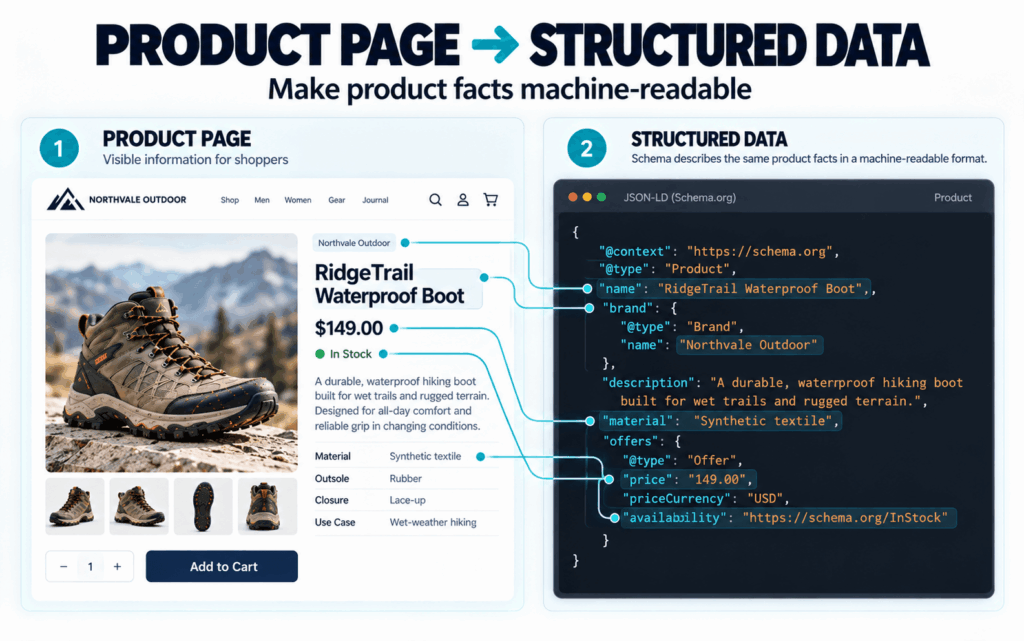
9. Add Relevant Structured Data
Structured data makes entities, attributes and relationships explicit in machine-readable form. It supports AI understanding, but schema markup for AI search isn’t a guaranteed ranking factor on its own.
Product and Offer structured data covers price, availability and core product facts.
Organization schema and BreadcrumbList structured data cover brand identity and site hierarchy.
FAQPage structured data marks up Q&A content so each answer is individually eligible for AI Overview and answer-engine extraction.
10. Strengthen Brand and Topical Authority
Build a connected body of content around what your brand sells and knows, instead of publishing disconnected “AI topics” chasing search volume.
Cover important entity attributes completely. Go deep on what matters to your core audience. That’s topical coverage, not topical padding.
Keep supporting topics connected to the core context. Resist the pull toward generic content that drifts from your actual business. If it doesn’t belong on your topical map, don’t publish it.
11. Strengthen External Authority and Corroboration
Building external authority means giving AI systems independent sources to check your brand claims against. Reviews, press mentions, Trustpilot ratings and Wikipedia or Wikidata presence all help corroborate what your own site says about itself.
How Do You Optimize Products for AI Recommendations?
Getting recommended by AI shopping tools starts with making your products easy to identify, compare and trust. That’s the real work behind any effort to get ecommerce products recommended by AI shopping and chat experiences.
Make Product Attributes Explicit
State the attributes that differentiate your product, clearly and consistently, so an AI system can match it against the right AI product recommendations without guessing.
Connect Products With User Needs
Explain who the product suits and the situation it solves for. This is what lets an AI engine match your product to a specific buyer question, rather than defaulting to a competitor whose page states its use case more plainly.
Provide Evidence That Supports Product Claims
Back up claims with real, specific details rather than vague superlatives. AI engines are cautious about repeating claims they can’t verify against other sources.
How Do You Optimize for ChatGPT Search?
Many of the same principles that improve AI search generally also improve ChatGPT Search visibility specifically. If you’re focused specifically on how to rank in ChatGPT Search, the fundamentals below are where that work starts.
Apply the Same Entity and Content Clarity Principles
Technical accessibility, explicit product information and clear semantic relationships matter just as much here. ChatGPT Search and ChatGPT Shopping both rely on the same underlying content quality.
Do Not Treat ChatGPT as a Separate Keyword Search Engine
Don’t build pages around artificial “ChatGPT keywords.” Focus on the real questions, entities and customer needs your content already needs to cover well.
What Content Formats Work for AI Search Optimization?
Format should follow the type of information behind your content for AI search, not a guess at what AI engines “prefer.” The same fact extracts cleanly or gets skipped depending on how it’s packaged.
Short answer passages win for single-fact queries: state the fact in one or two sentences before adding context. Lists and numbered steps win for anything sequential, like the framework above. Comparison tables win when a shopper is weighing attributes side by side. Don’t force that into prose. Detailed product and category information still needs full depth where a decision genuinely requires multiple attributes; don’t over-compress it into a short answer that leaves out what the buyer needs to decide.
What AI Search Optimization Mistakes Should Ecommerce Brands Avoid?
These are the AI search optimization mistakes we see most often, and avoiding them does more for visibility than any single fix below. Most trace back to the same handful of AI SEO mistakes: fragmenting content, chasing volume outside your topic, and treating structured data as a shortcut.
Creating a Separate Page for Every Similar Question
This is content cannibalization: thin, near-duplicate pages compete with each other instead of building one strong, well-answered page. Consolidate overlapping questions as supporting detail on a single page.
Publishing Generic AI Content Outside Your Topical Context
Chasing unrelated “AI” topics for search volume dilutes your site’s actual focus and weakens the topical signals that matter.
Keyword Stuffing for AI Search
Keyword stuffing doesn’t substitute for clear entities and real information. It degrades the exact passage an AI engine would otherwise extract cleanly.
Relying on Schema Alone
Structured data should reinforce your content and relationships. Google’s own structured data guidelines confirm it enables a feature to be present, not guarantee it, so it can’t replace thin or vague underlying copy.
Ignoring Commercial Pages
Product and collection pages are core entities in your store. Don’t neglect them while chasing informational content.
How Do You Measure AI Search Optimization Performance?
The AI search metrics that matter go past “did we get mentioned” and into traffic, conversions and revenue. The goal is to measure AI search visibility, traffic and revenue together, not any one of them in isolation.
Monitor Relevant Brand and Product Visibility
AI visibility tracking means watching whether your brand and products surface for the queries and topics that matter most to your business.
Measure AI Referral Traffic
Use GA4 referral-source segmentation (the source/medium dimension) and Search Console to identify sessions coming from AI platforms, and see which pages they land on.
Measure Conversions and AI-Referred Revenue
A report that only shows rankings doesn’t tell you if any of this made money. That’s the AI search ROI question most reports dodge. Tie AI-driven visits back to actual conversions and revenue wherever attribution allows. On one client’s ecommerce SEO and AEO case study, ChatGPT referrals alone generated $4,180.80 in attributed revenue across 7 orders, a $597.26 average order value, proof that AI visibility can convert into real, provable sales, not just citations.
How Should Ecommerce Brands Prioritize AI Search Optimization?
Fixing technical and accessibility problems before investing in content isn’t arbitrary. Content improvements on a page AI crawlers can’t reach produce zero visibility gain, so getting your AI search strategy in the right order matters.
Fix technical and accessibility problems first. Confirm AI crawlers (OAI-SearchBot, PerplexityBot, Claude-SearchBot, Googlebot) aren’t blocked and that key content isn’t hidden from them.
Improve high-value product and collection pages. Prioritise the pages tied to your most important products, categories and revenue. A fix on a page that already gets queried often compounds right away; the same fix on a rarely-visited page just sits there.
Close important content and entity gaps. Fill in missing questions, attributes and relationships before expanding further.
Build supporting content and authority. Grow the wider topical network once your core commercial pages are solid.
Does AI Search Optimization Replace Ecommerce SEO?
No, AI search optimization doesn’t replace ecommerce SEO. If you’re asking does AI search replace SEO hoping to skip the technical basics, the answer is still no. It extends strong SEO fundamentals, technical, commercial and content, into AI-assisted search experiences. You still need both.
Frequently Asked Questions
Here are the frequently asked questions ecommerce brands raise when rolling AI search optimization into an existing SEO program.
What Does a Shopify-Specific AI Search Optimization Engagement Include?
If you’re asking what’s included in AI search optimization work specifically, a Shopify-specific engagement covers schema implementation, entity clarity work across brand and product pages, content restructuring around real buyer questions, and ongoing AI visibility measurement. At iWeb Power, AEO and GEO are built into the retainer from day one. They aren’t sold as a later upsell.
What Should You Budget for Combined SEO and AI Search Optimization?
Budget for SEO and AI search visibility as one connected program under one team, not as two separate line items competing for priority. There’s no fixed combined SEO AEO GEO retainer cost that applies to every store. The exact figure depends on your store’s size and current state, but combining both under one retainer avoids paying twice for overlapping work.
Do Agencies Offer AI Search Optimization by Default, or as an Upsell?
Many agencies still treat it as an AEO GEO bundled service you buy later, once ChatGPT traffic forces the issue. We build AI search optimization included by default into every retainer from the start, so you’re not paying extra later for something that should have been there from day one.
Ready to Improve Your Ecommerce Visibility Across Search and AI?
If you’re tired of SEO agencies that hand you a ranking report and call it a win, or you’re watching your ad spend do all the work while organic traffic stays flat, this is built for you. We help Shopify and Shopify Plus brands build visibility across both traditional search and AI search experiences, with AEO and GEO included by default, not sold as a later upsell, and success measured in qualified traffic, conversions and revenue you can trace in your own Shopify backend. Check our ecommerce AEO and GEO services for AI search engines, or book a free 30-minute strategy call to see where your store stands today.
